
Welcome to the GAIN Blog
The blog is updated Monday-Friday. Tune in for posts and discussion about health, fitness, nutrition, training experiments and reflection. We share articles, videos and more. We post the link to our Instagram story every day, make sure to follow along there to never miss a post.
Buffer Time
When you go to the gym, it’s easy to check out of the rest of your life for a while. You can leave your phone in the car, put work thoughts on hold and fully commit to yourself for an hour to so.
You have to drive to the gym in order to start. Maybe you crank some music, which I know many of you do since we can hear you pulling into the parking lot. This buffer period gets you mentally ready to train, whether you’ve realized it or not. Just like my 30 minute drive home at night gets me ready to cook dinner, put my phone on silent and hang out with my wife.
While we’re training at home, we don’t have these buffer times to get us ready for the next task. We can’t drop everything and train, because we’re trying to balance everything and train. Trying to go from emails to cooking dinner is equally as tough.
To combat this, I’ve been trying to build in buffer times around things. Take a walk before a workout, stretch before cooking dinner and commit to leaving my phone out of reach while training. All these things help create those buffer zones so I can try to focus on the task at hand - not everything at once.
How have you been shifting gears while trying to do everything at home?
Justin Miner
@justinminergain

Just for Fun
I ran twice this week.
I’ve only gotten out once a week for a month now. It’s weird, because, I love getting outside, being in the woods and trying to move quickly through varied terrain. I love breathing heavy, stomping through puddles and flying downhill. To put it simply, running is fun.
Since February, I've been training for some races. Racing is fun, but I do it more for the challenge. Can I adapt well enough to handle this race? While running is fun, training for a race is tough. It requires all out speed work, weekly milage goals, a lot of hill repeats and long runs that last hours. A strict training schedule keeps you going when you don’t feel like it. You have an end goal to help you make better choices with training, sleep and nutrition.
I anticipated my races being canceled, and I even anticipated my motivation dropping off afterwards. What I didn’t expect was that my desire to run would completely disappear. I had relied so much on motivation from those races that I forgot why I ran in the first place, because it’s fun.
I ditched having a plan and decided I just needed to get back to it on Monday. It was pouring rain, kind of cold and windy. I thought if I got a run in under these circumstances and had fun, it would build momentum for the week. I removed expectations and just got out there for fun, like I used to.
I got back to the trailhead and got in my truck. I was soaked, breathing hard and my shoes were filled with water. I really missed that, I thought. I wasn’t referencing running, but instead, running just to run. It was the reminder that I needed to have fun. To not stew on circumstances out of my control and to be okay with doing something just for the sake of doing it.
If you’re feeling like you have no motivation, that’s completely understandable. We’re all dealing with the unknown. This weekend, do something just for fun, not for the sake of training or fitness or health, but just because you want to do it.
Justin Miner
@justinminergain

Friday Workshop Series - Foam Rolling
This Friday we’ll be continuing our weekly Workshop Series.
This week is all about foam rolling. Learn what it’s all about, how to hit those hard to reach places and have a discussion about what’s even going on when we roll.
Any type of roller you have is good. Join us at 5pm for a 30-minute roll. Loosen up all those tight spots and wind down heading into the weekend.
(free for members and non members, spread the word!)
Justin Miner
@justinminergain

Gear Shifting
Everyday I try to get outside in the afternoon for some informal training.
A simple workout with no equipment, or just a kettlebell, out in the sun, is wonderful. Even if it’s only a 5-10 minute workout. Getting out, listening to some music, a podcast or nothing at all had really helped me try and shift from work-mode to at-home-but-not-working-mode.
The other day when I was headed into the garage, I said to Hannah, I’m going train. Didn’t you already workout, she asked. Well, I had, but she’s still thinking about working out as the big 60-minute event it used to be for all of us just a month ago. I’ve shifted what I think training is, and instead use it as a way to create more movement throughout the day.
I headed into the garage, then to the driveway to do whatever random thing caught my fancy. Jump rope, kettlebell swings, walking lunges down the driveway, overhead carries. No rhyme or reason to any of it, just an excuse to be outside, moving, connecting with my body.
If you are having a hard time shifting gears from homeschool teacher to employee to chef and whatever other role you’re playing now, I recommend that you get outside and move around, with or without a plan.
Justin Miner
@justinminergain
Fundamentals
Did you play sports growing up? Even if you only made it to tee ball, you probably remember your coach harping on fundamentals. In little league, I had a coach who would cheer from the dugout, FUN-DA-MEN-TALS, while my teammates and I were up to bat. Playing hockey, fundamentals were brought up in each and every practice from mites all the way through college.
This post was inspired by a podcast I heard, a guitar player was explaining that it’s all fundamentals. You need to practice the fundamentals for a period of time everyday in order to get good. He went on to explain if you want to play like Hendrix or Santana, that you need to first master the fundamentals so well that you know how to break the rules.
Working out is the same thing. We all need to develop, and continue to work on, the fundamentals. Squatting well, nailing a push up, stabilizing our spine, opening up our hips. These are all fundamental positions and shapes we all need to get in for us to be effective humans - to navigate the world without limitations.
Simple training works. Period. Most of the time, we get bored with something and move on too soon, before we even really understand the fundamentals of it. I have some good news for you, now more than ever, the fundamentals are what we should be working on.
Bodyweight squats, hip hinges, planks, hollow holds and push ups are the foundation to build a strong, stable and capable body. Take this chance to master these movements, learn to understand them in a new way. Right now, more than ever, we have no excuse to be bad at the fundamentals.
Justin Miner
@justinminergain

That Time I Got Pinned
After I got my license, I started driving myself to the gym everyday after school.
Great Bay Athletic Club was never overcrowded at 3pm like it would be in a couple hours. Besides me, there were afternoon regulars. A couple of old-school bodybuilders with thick training logs and the trademark thin and low tank top, a pair of older kids from my high school and my lifting buddies. I had just gotten into working out. I wanted to be a better hockey player but mostly, I wanted to look good.
In the strength world, it’s a right of passage to do something with 135 pounds. The barbell itself weighs 45 pounds, and before bumper plates we common, the only large diameter plates were metal 45 pound plates.
On this afternoon I was the only person there, none of the weekday usuals were around. I went on to do my typical warm up. Shot some free throws on the basketball court, worked on striking the speed bag, and a mainstay in warm ups at the time, arm circles with 2.5 pound plates.
This meant I was going to bench press. It's what all the stronger guys in the gym did before they benched, and that was pretty much what most people here did, bench press. I got my program from Flex magazine. A true bodybuilding split-style. Chest, shoulder, triceps twice a week, back and biceps twice a week and two lower body days. One dedicated to hamstrings and glutes, the other was quads and calves.
The program, my first introduction to progressive overload, decreased reps each week, intended to make you use heavier weights. Towards the end of the program, I was down to 4 reps for my main exercise of the day.
I continued the customary warm up, 10 reps with the bar, small 10 pound plates on each side, 10 reps there. I remember looking around, surprised none of my friends had shown up or at least the bodybuilder who always wore zebra print pants. I swapped out the 10’s for the stout 25’s. The reps there felt good enough that I put the 35 pound plates on the bar, now equalling 115 pounds.
The reps were good, and I rested a while. Eager to become strong I loaded up the bar with status, 135 pounds. I walked around in my Nike Shocks, obligatory homemade tank top and basketball shorts. I was going to get it, for the first time.
If you’ve been lifting for a while, you know if you can get the weight as soon as it leaves the rack. I hadn’t had nearly enough reps to know there was no chance I could get this barbell of my chest. I lowered it under control, using what I thought was good technique.
When the bar touched down, I stopped thinking about lowering the weight and pushed with all my might. The bar started lifting, gaining a bit of speed, then dropped onto my chest. My right leg kicked out when it landed. I was pinned. No one was around. Embarrassed, I wiggled, grunted and heaved, trying anything to get out. I couldn’t budge the bar.
Finally, some guy walked down the hallway from the locker room on the the gym floor. Immediately he noticed me on the bench. Several minutes into my predicament, I was just laying there, hoping for rescue. He ran over, lifted the bar off my chest and asked if I was okay. Instead of lecturing me, which I’m sure would have resulted in me abandoning the whole gym thing due to embarrassment, he said it happens, don’t worry about it, and went on his way to the cardio theater.
That wasn’t the last time I would get pinned, but it would be the last time I did it without a spotter. I kept working my bench press too, eventually, building to the point where 135 pounds was an acceptable warm up weight.
I’ve been reflecting a lot on how I got started working out, and how I was able to instill this important habit into myself at a young age. Looking back, I’m thankful that guy was nice, and didn’t scare me away from the gym. To whomever you were, thanks for the help.
Justin Miner
@justinminergain

Trigger Workouts
You may be having a hard time adjusting to your new daily routine. If you’re like me, your training schedule is a bit off. I was in the middle of training for two big races in May, ever since learning they were cancelled, my excitement to train and run has dwindled.
I was introduced to this concept of Trigger Workouts from this article on Precision Nutrition and it’s been a game changer for me. Since I’m not feeling up for big, epic, planned out training sessions, I instead aim to hit certain movements throughout the day and try for one 10 minute session with some intensity.
The idea is simple, have an object, say a yoga mat on your living room floor, every time you walk over it, do 10 push ups. Every time I go in the garage, I do 5 pull ups. Some days, I’ll leave a kettlebell on the deck and whenever I’m bored I’ll go do 20 or 30 swings. These mini sessions allow me to get some more movement in, broken up over a long day, and perhaps most importantly, lets me get a training effect in without having to try too hard.
There’s a lot of stuff going on right now, and it’s okay if you’re not up to the usual task of a 60 minute workout. That doesn’t mean your body doesn’t want to move though, feeding it movement and training in these mini session throughout the day could be a gamer changer for you.
Here’s something for you to try today:
15 bodyweight squats, every hour on the hour. Every time the clock hits an hour, press pause on what you’re doing and do 15 squats. Before you start calculating excuses - 15 squats will take less than 30 seconds, you can do it!
Justin Miner
@justinminergain
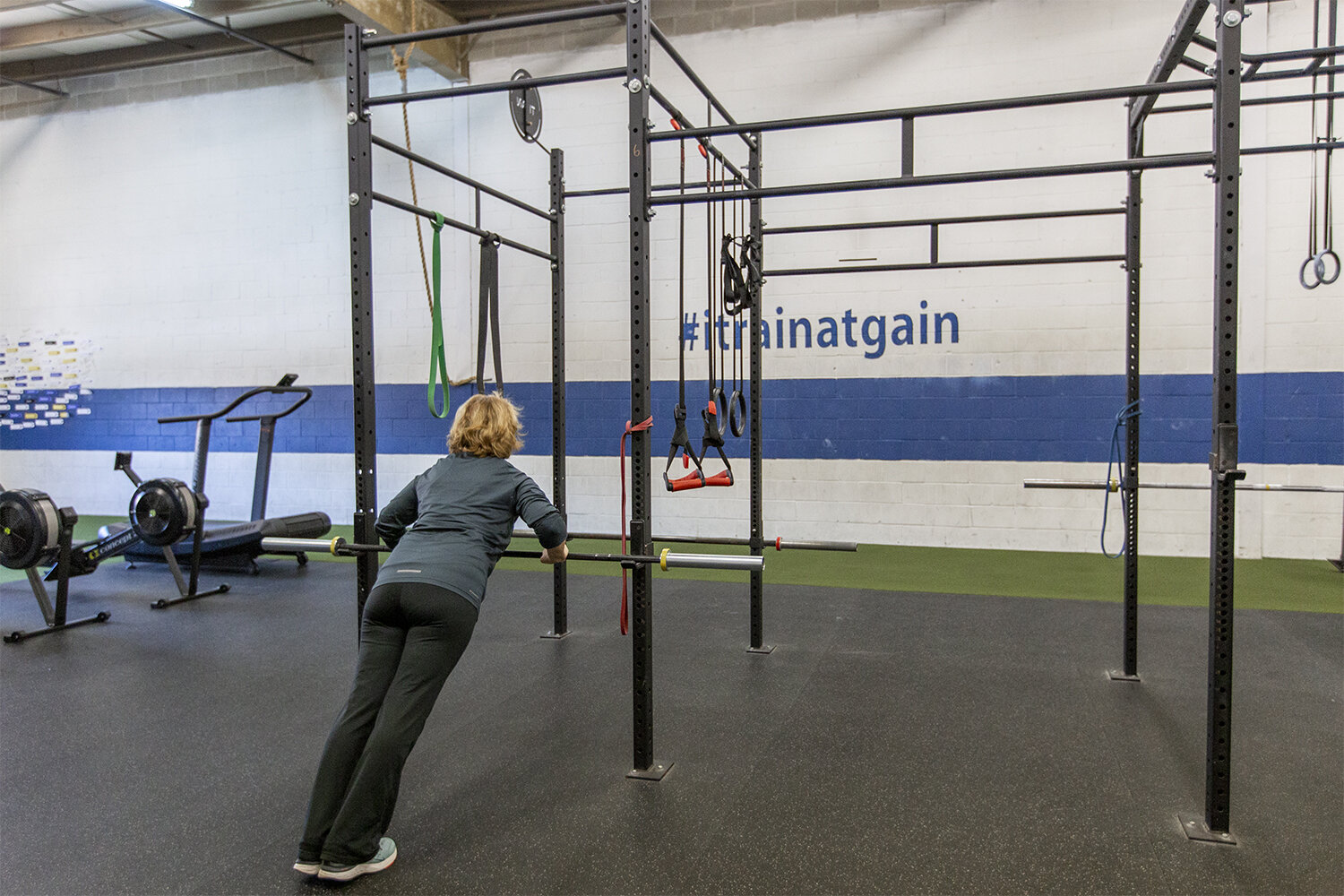
Turkish Get Up Workshop
The first time I heard about a Turkish Get Up was in college. I had a phase where I was obsessed with kettlebells. It was the only thing I used to train and I was convinced they were the source of all good things health and fitness. Then and still to this day, the authority on all things kettlebells is Pavel Tsatsouline.
Known by just his first name, Pavel is credited with bringing this Russian style of kettlebell training the the United States. I read his book Enter the Kettlebell and gained endless insights I still think about today.
One of the most challenge, technical movements from the book was the Turkish Get Up. A 14-step ground to standing to ground transition. The move demands shoulder stability, hip mobility, hip strength and the ability to create a rigid torso - all while holding a weight over your head.
This week, in our Friday Night Skill Workshop, we’re talking all things Turkish Get Up. We’ll break down the movement, simplify the steps and build you the foundation to keep practicing this effective total body move.
No weights are required for this workshop. Like in my college Exercise Prescription class, you’ll have to prove you can do it while balancing a shoe on your hand before you're given a weight. All are welcome, you can register using the Zoom link below. We’ll be kicking things off tomorrow evening at 5pm.

Ice Cubes and Progress
As I mentioned last week, I’ve been spending some of this time around the house flipping through books I’ve already read, trying to gain some new insight. When I was thinking about what to write today, I reached for Atomic Habits, it’s been awhile since I shared any ideas from this game changer of a book.
The ice cube metaphor may feel like a punch in the face if you think you’re not making any progress.
Imagine you have an ice cube on a table. This room, where you ice cube is sitting, is temperature controlled. Starting at 20 degrees, we’re going to raise the temperature of the room 1 degree at a time.
After a while, we’re up to 25 degrees. No change on the ice cube, it’s still just sitting there, frozen. Fast forward a little longer, we’re at 30 degrees. Still no change to the ice cube. Once we hit 31 degrees, our ice cube is there, unchanged and apparently unfazed by the increasing temperature.
Finally, we hit 32 degrees. The ice cube starts to change, it’s melting.
What made the ice cube melt? The 1 degree change from 31 degrees to 32 degrees? Or was the the compounding of the temperature change to get there? We saw no progress from 20 degrees all the way to 31 degrees. Now, just because we couldn’t see the progress, doesn’t mean it isn’t there.
You might be going through something similar now. It feels like your turning your wheels, not getting any traction. You could be making progress and adapting now, it just isn’t visible yet. Remember the ice cube, you could be making change without even knowing it, small actions add up to big changes.
Justin Miner
@justinminergain
Fitness Reassurance
The other day I touched some weights for the first time.
As you may know, my garage is full of gym equipment. When we were looking at houses, a garage was a “must have.” I knew I wanted an easily accessible gym I could use without having to get in a car.
It’s been a game changer for the past several months. Random sets of squats, bike workouts when it was -8 degrees outside and space to tinker around with stuff. When the gym closed, I decided to pretend none of that was there. If I was saying the at-home workouts were world-class, which they are, I better step up and do them with everyone.
I went 23 days without using my home gym. On Sunday, it was nice out, the sun was hitting a spot just outside the garage. I felt like it was time to see how a weighted movement felt after so many weeks off.
I set up a barbell, rolled it out of the garage and on to the driveway. I did 4 sets of 10 overhead squats. They were clean, spacious squats. My positions felt good, my muscles were happy and I was pleased that I didn’t struggle like I had anticipated.
This blog isn’t about home gym bragging. Instead, it’s a message to you, the person that thinks all their fitness is going to disappear during quarantine. It won’t, in fact, the exact opposite may happen, you may feel stronger and own the positions better. Keep it up with the bodyweight, or minimal equipment workouts, once we’re back in the gym, you’ll be pleasantly surprised.
Justin Miner
@justinminergain

Small Wins
Two weeks ago I set 3, easily achievable, daily goals. I did well on it. It got me out the door for an extra walk when I didn’t feel like it, had me reaching for a book instead of my phone after lunch and I did my mobility work every night after dinner.
Last week, I didn’t plan to hit these goals everyday like the week before. I made the mistake of assuming it would happen without as much effort. But then it was rainy, raw and cool out. Scrolling my phone became easier than reading and I found myself really needing some mobility work near the end of the week.
It was still too new to not require any effort. I thought, I already made all these small wins, they’ll just happen this week. We must be active with our goals, we must respect the weight they carry and be willing to strive for them.
I’m being a little more deliberate this week about setting goals. I wrote them dow in my notebook where I’ll look at them every day. I hope you’ll join me and set some realistic goals to keep you focused this week.
Justin Miner
@justinminergain

What's it Mean to be Antifragile
The concept of antifragility has helped me a lot over the past two weeks.
Nassim Taleb is a former options trader and risk analyst turned modern philosopher. His work focuses on randomness, probability and uncertainty. He created this idea of antifragility.
When something is fragile, it can easily break. In Taleb’s words, it's victim to volatility. If something is not fragile, it is robust. It can withstand forces, won’t easily break. For example, a glass vase is fragile, it’ll break when you throw it down the stairs. A robust vase, will handle the blow. It’s a resilient vase, it handles the fall but stays the same.
This is important to remember. Antifragile isn’t just the opposite of fragile, robust is. Antifragile takes it a step further. Not only does it not break, it gets stronger with adversity. Each time that vase is tested, whether knocked over by a dog’s tail or an earthquake, it comes back stronger than before.
That’s what it means to be antifragile. Getting stronger, more capable every time you’re tested. It means having options, the ability change course and using adversity as a chance to get better, to improve. Keep that in mind during these times. How can you make it so you’re antifragile?
Justin Miner
@justinminergain

The First Time I Ran
Before opening Gain, I had a serious rough patch. After a year of cautiously training to not aggravate my back and my hip, I took a year off from all working out. As a former athlete, I had nothing to train for. The feeling of no motivation combined with fear of making my injuries worse kept me me away from the gym.
Running always hurt. In college, during captain’s practice we would run down Hills Beach Road. Every time, no matter would I would strain a groin muscle. It would leave my limping for a day or two and eventually it would go away until our next running workout.
I remember thinking back then, when running was so painful and boring to me, that I should run a marathon one day. I hated it so much and it was so uncomfortable, I felt like I had to try and put that aside and try a marathon, eventually.
That thought left my brain and I hadn’t thought about it for many years when I decided to run with Hannah on a Saturday morning. It was spring 2014 and I had recently started to get back in the gym. I was getting my injuries under control and dedicated a lot of time to rolling and stretching. My new motivation was to be a human. I wanted to move well and stop hesitating for fear of injury.
That meant I needed to learn how to run, without getting hurt. I dove into running mechanics, learned about the Pose Method, and prioritized the skill of running over running for time or distance. I still didn’t like running, but felt like I should be able to run.
That Saturday morning, Hannah and I headed out of my Hampton apartment with a goal to run the 1.2 miles to the Secret Spot. Breakfast burritos and iced coffee were an excellent motivator.
I thought about how to lean and fall to create momentum, how to quickly pull my foot off the ground after letting it kiss the pavement for only a fraction of a second. Upon reaching our destination my calves seized up, my achilles tendons ached and the bottoms of my feet we displeased with my decision to run.
We ate our breakfast burritos while watching cars full of people drive by headed to the beach. We decided to walk home, not run. This became our weekly ritual throughout the whole summer, my first real introduction to running.
One day in September, we ran down and found the place boarded up. Closed for the season. I forgot about running after that summer. It would be another two years, after we got Clementine, that I discovered trail running and finally started calling myself a runner.
Justin Miner
@justinminergain

Rereading
I hate borrowing books. I want to fold pages and take notes. I want to break the spine so it can lay flat, becoming easier to read. We jokingly call our home office the library. Besides the desk Hannah has set up, all there is for furniture are two book cases, stuffed full.
I like looking at them. Seeing what title captures my eye on any certain day. I’m trying to pick out the ones I enjoyed, or learned a lot from and even ones I didn’t particularly like the first time around. Dan John, legendary strength coach, who, I’ve brought up here many times, has this saying, which inspired me to focus on flipping through old books instead of ordering new ones.
"Make a difference. Live. Love. Laugh. Balance work, rest, play and pray (enjoy beauty and solitude). Sleep soundly. Drink water. Eat veggies and protein. Walk. Wear your seatbelt. Don’t smoke. Floss. Put weights overhead. Pick weights off the floor. Carry weights. Reread good books. Say thank you.”
There it is, reread great books, right at the end of a list of things we should all be doing or striving to do. As I’m rereading, I’m focusing on seeing if I can learn something different this time around. Watching to see if my perspective has shifted or if I understand anything differently. I encourage you to do the same.
Justin Miner
@justinminergain

Side Planks
For years, I’ve underestimated the power of side planks. I thought, I’m strong, I don’t need to do side planks, those are a beginner exercise. Truthfully, I just found out, the real reason I have been avoiding them is that they’re brutally hard!
The stability demands placed on the outside of your hips is, substantial, to say the least. They work shoulder and scapula stability, breathing mechanics and anti-rotation core strength.
At the gym, we lean on the anti-rotation press as a lateral stability/anti-rotation go-to. We’re always trying to find holes in our game and improve though. Since we’re not relying on people having a band, or a post to tie it to, which is more difficult to find than you would imagine. We’re doubling down efforts to build strength and stability in the side plank.
The key to improving them is to stay within your limits. Don’t push it too long, modify by placing knees on the ground if necessary and always be willing to cut it short if you need to. Use the prescribed breaths or seconds as a guideline, you don’t have to get to 10 breaths, just because that’s what it says.
Justin Miner
@justinminergain

Opportunities
Now, more than ever, we all have a chance to get better.
There isn’t a gym open on the planet. We all have access to more fitness, more time and more opportunities. You might need to change your own story to make it work.
Hate working out at home? Go to a park, but I can assure you, there isn’t a gym to head to. You may want to get over that. If you’re a wake up early and head to the gym before work person, maybe you should try training after work. Like I said, there isn’t a gym to go to, anywhere, so you might as well try shaking up your routine.
Maybe you’ll do 100 kb swings every night after dinner or take a long walk after coffee in the morning.
However you grasp this opportunity, it isn’t going to be spending 60 minutes in a gym, three times a week. We can eliminate that choice. You don’t need to change, drive to the gym, get gas on the way. All of those choices have been eliminated. The only thing left to decide for yourself: what are you going to do to seize this opportunity?
Justin Miner
@justinminergain

We're In This Together
Now, more than ever we should be making health a priority.
It’s easy to sit around the house, eat junk, watch too much news, not drink any water and have a couple glasses of wine a night.
I don’t intend for this message to come with doom and gloom, but instead, a new perspective; an opportunity for growth and a chance to focus in on what matters.
How can I help you? Need a weekly FaceTime chat to keep you in line? Need certain stretches you should do on the daily? What about more customized workouts? Anything you need, Alex, Taylor and I are here for you.
We’re going to keep supporting you however we can. I hope you’ll continue to support us too, so when this is all over, we can get back to our normal routines and schedules in the gym. Until then, we’re going to keep up this massive effort and I hope you stay with us through it.
Thank you.
Justin Miner
@justinminergain
Fundamental Movements and Training Principles
The beauty of strength and conditioning is that it’s simple. The principles used to create the most complicated, science-backed, high-level, detailed (complicated?) strength and conditioning programs can be scaled down and used by everyone using only bodyweight.
The fundamental movement patterns are just that, foundational movements that humans should be able to do. They’re movements that look like sitting down, getting up from one knee, pushing things away from you, pulling stuff towards you and bending over to pick something up. We see these shapes in daily life and in high performance athletic events. It’s why we don’t have machines in the gym anyway, can you imagine trying to recreate those movements in the comfort of your living room?
We define the functional movement patterns as follows:
Squat
Hinge
Push
Pull
Single Leg
Core/Carry
In our world, nothing else exists. These are the global movements that will cover our basis as humans, so long as we train with sound principles. Here are the principles we use to guide or programming, whether in a gym full of equipment or in a living room with no equipment at all.
Work within a safe range of motion
Scale movements and add variables as needed
Build functional strength through skill development, practice and repetition
Develop a robust core
Develop your cardiovascular system at different intensities
Improve mobility, flexibility and stability
As we head deeper into this quarantine, you may start to feel lost. Like you’ve lost direction in your training. That’s understandable, we’re in a unique situation and you’re out of your normal routine. It’s a chance to work on some new, different goals though. Instead of missing out on what you normally do, know that we’re still training you with these principles in mind. Will your deadlift max dwindle a little bit? Perhaps, but if you stay fit, move well and continue to follow these training principles, all your former strength is going to be within reach after just a few training sessions.
That’s what we’re doing with the workouts we sent you and the daily workouts we’re posting. We’re embodying these principles and movement patterns to make approachable workouts for you. Is it as hard as 5 down and backs with a heavy sled? No, but working on your forward lunge pattern is similar, and can have a similar training effect for your muscles, tendons and joints. Stick with the plan and not only will you maintain the strength and fitness you’ve built, you’ll continue to cultivate it so when we’re back in the gym, you’ll jump right back to normal.
Justin Miner
@justinminegain

It's Unreliable, Anyway
Motivation is pretty unreliable. We think it’s the magic sauce that’ll take us to the next level and carry us through to see our goals. Many of you have told me over the past several days that your motivation to workout at home is dwindling. The good news is that you don’t need it, you just need to shift your perspective.
Instead of needing motivation to workout, you need discipline.
The backwards part of this is that from discipline comes motivation.
Let’s back up and define these terms.
Discipline (verb): to train or develop by instruction and exercise especially in self-control.
Motivation (noun): the general desire or willingness of someone to do something.
Motivation can be our initial push to do something. The first time you walk in the gym or the first week you’re quarantined at home and forced to workout via Zoom. The issue arises when you think that motivation is going to stick around for you. It short-term, non-lasting and unreliable. It’s finite, we can always rely on it running out, eventually.
Whether conscious of them or not, our daily lives are built on habits that we’ve created. When motivation dwindles, it becomes more and more difficult to stick with the new habit, like working out at home. That’s where discipline comes in, and we need to learn how to harness it. We can’t just wait for motivation to come back, you’re calling for it and it isn’t going to answer the phone.
Through discipline, we can set up new rules, which will turn into habits for us to stick to. Set a time for your daily workout. Set small goals to build momentum. Habits don’t need to be epic, they can be reasonable. The point I’m trying to make: don’t wait for motivation to come back, it’s not going to. Instead, shift your perspective, find some discipline and get to work. It won’t be easy, but it’s your only option if motivation is gone.
Justin Miner
@justinminergain

Set Small Goals
We’re all shifting focus, finding new routines and figuring out how to deal with this situation. Last week, I was all over the place. I stayed up really late, slept poorly, consumed too much news and had a hard time getting in a groove.
Yesterday, inspired by Taylor, I set 3 small daily goals. These mini-goals gave me some structure, something to fall back on yesterday when I wasn’t sure what I should be doing.
My goals were:
Two walks a day
Read fiction
Mobility and stretching after dinner
I got them all in yesterday and it was a nice way to build momentum. So now I’m asking you, what are you goals for the week, or for the day? How are you going to improve, or make the most of this situation? What have you been neglecting that you can focus on?
We can’t control the situation but we sure can try to make the best of it. Set some small daily goals for yourself and you’ll be surprised at how good it can make you feel to have some direction.
Justin Miner
@justinminergain
