
Welcome to the GAIN Blog
The blog is updated Monday-Friday. Tune in for posts and discussion about health, fitness, nutrition, training experiments and reflection. We share articles, videos and more. We post the link to our Instagram story every day, make sure to follow along there to never miss a post.
Don't Forget About the Consistency
Becoming a new dad has me doubling down on my nutrition efforts. I’m thinking down the road and I want to be sure I’m doing all I can to stay fit and healthy for many years to come. For the last handful of years I’ve been anti-supplement.
Not that I necessarily have anything against them. I just never remember to take them. And how effective is it if you take it for half the recommended dose half the time? I’m not sure.
Well, after some blood work, I have some specific measures I want to bring up and will retest in a year to see if I can make any changes through supplementing with things I don’t get enough of in the food I’m eating. This blog isn’t about what the supplements are though. Instead, it’s about remembering to take them.
Just like going to the gym, I need to flex my habit development muscles to make sure I’m taking these things every day to get the most benefit out of them. I’ve been working them into my coffee routine. Sometimes pre-coffee, sometimes while making coffee, and sometimes after coffee. And sometimes while making dinner when I forget to take them in the morning.
It’s hard. It’s silly that it seems so hard to remember to take a couple pills. But it just again shows how much our routines and habits shape our day. Just the addition of the smallest thing can be difficult.
Whatever new habit you’re trying to build, whether it’s taking a vitamin D supplement or showing up to the gym three times per week, remember, it is all about consistency.
Justin Miner

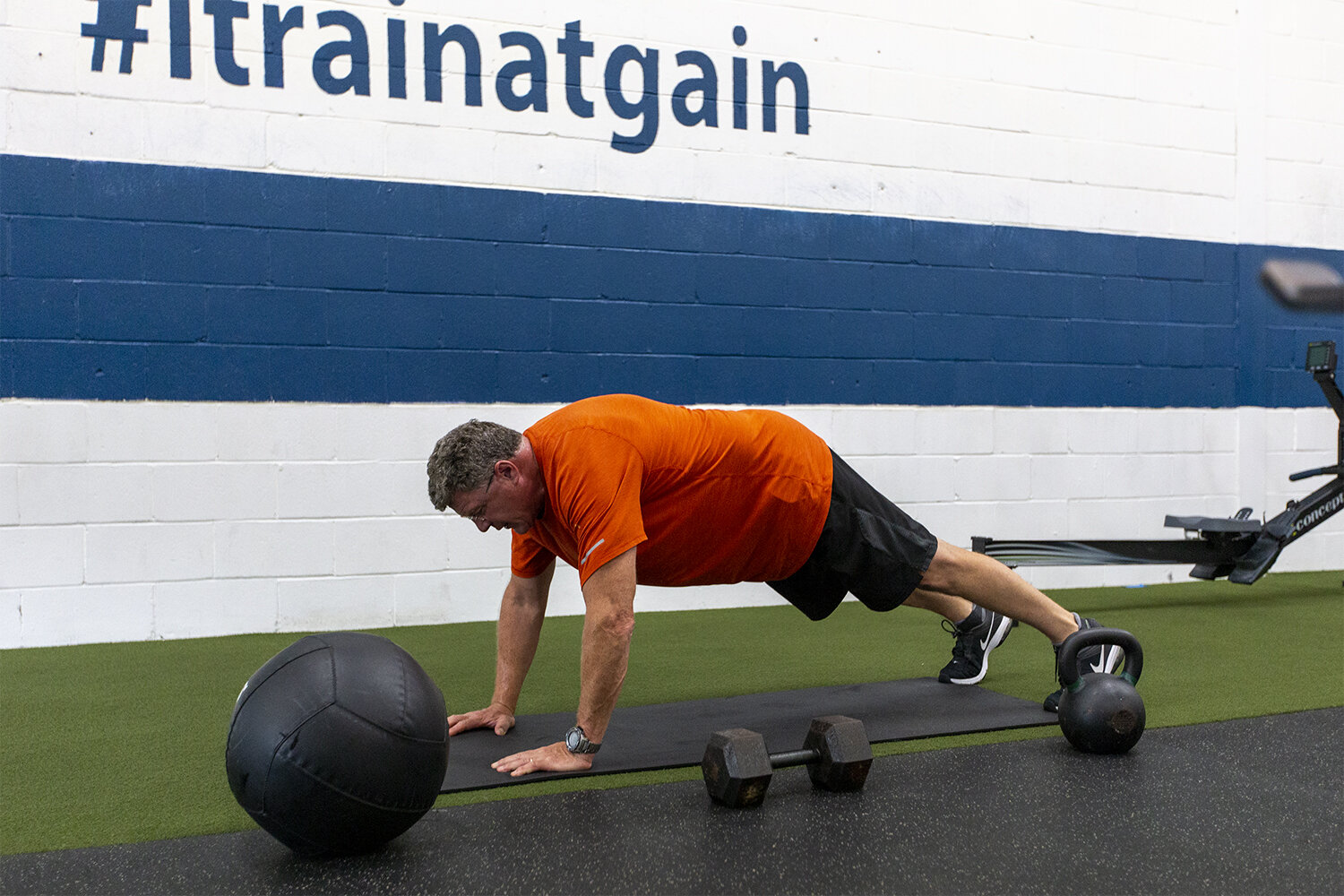
Poor Push Ups
They get regarded as a basic exercise. They’re not appreciated for the technical, challenging movement that they are.
On the surface, they’re a chest exercise. That’s what a muscle poster in a commercial gym would tell you. But in reality, they’re so much more.
They challenge your hip and core stability, wrist mobility, and you ability to stay stable and connected as you move and breathe.
The key to a perfect push up is properly using your upper back, or moving you shoulder blades as you lower yourself to the floor.
The next time they come up on your list, don’t write them off. Move slow. Be purposeful. Try to use your whole, entire body, not just your arms.
You’ll be surprised at how hard that can be!
Justin Miner
Don't Forget to Squeeze
It’s not uncommon for a client to admit they have poor grip strength.
Grip strength is important, too. You grip strength is a good indicator of total body strength.
So, what are we supposed to do?
The good news is we don’t need to add another thing on your list to do. Instead, we need to increase you awareness around certain movements so you can train your grip as well.
During marches, rows, deadlifts and even squats and push ups, you should be engaging your body through your hands. Squeezing the implement you are using creates irradiation. Meaning it turns on more stuff to help you stabilize.
Train your grip more during the movements you’re already doing, you’ll be surprised how much of a difference it can make.
Justin Miner

Routines
Humans love routines. Our habits and routines form our daily lives.
Do you ever stop to think about your routines, and how they’re impacting you?
At home, we’re developing a whole host of new routines as new parents. It’s been making me think of my old ones, new ones and how these routines shape out lives.
Have you developed a new routine lately? If not, maybe it’s time to shake things up and try something new.
A subtle shift can give you new perspective, more time and refreshed energy.
Justin Miner
Fast But Smooth
I love this saying, and find myself repeating it in my head while hiking, running or even sweeping the living room.
Slow is smooth and smooth is fast.
Recently, I’ve talked a lot about how we need to be able to produce strength quickly, and how that impacts our overall strength. Moving quickly is a main part of the equation.
Have you ever seen someone try to pick something up that’s just too heavy?
The lifter can try to overcompensate for a lack of strength through speed. The result?
A jerky or yanking motion opposed to a smooth production of force. People get hurt when they try to jerk weights or objects from the floor.
The point of today’s discussion: we want to be fast, but only if we’re stable, only if we’re smooth.
Fast in poor position is a mishap waiting to happen. Let’s master those positions, be stable, then work on speed.
Justin Miner

When Was The Last Time
When was the last time you did something you didn’t think was possible?
Time in the gym gives us access to these moments where we complete the impossible.
Maybe it’s lifting a heavy weight, learning a new move or carrying your paddle board to the water all by your self.
Whatever it is, you’re capable of so much more than you ever thought. All it takes is a some consistent training and you too can shatter your former beliefs and do the impossible. Get to work.
Justin Miner

When Should Your Weight Increase?
In this week’s Deep Dive Video, I talk about signs that you should try and increase the weight on a certain movements and what scenarios you should do more reps than prescribed on your whiteboard.
As a general rule, we want the last 2-3 reps of the movement to be the most difficult.
More important than the load, however, is how the movement feels.
Before even thinking of increasing weight, be sure to have your form dialed in. It might take many weeks with the same weight for this to happen, and that’s okay!
You’ll know you’re ready - when you feel like you could do almost double the prescribed reps, or those last two feel exactly like the first two.
Watch the video on IGTV to catch the rest, like when you should lower your push up bar, or adjust your body’s position on inverted rows.
Justin Miner

Rowing Machine
When using the rower, it’s more helpful to think about your legs than your upper body.
The name of the machine, rower, tricks us into believing it’s an upper body machine, when in reality, it’s more about your legs than anything else.
When rowing, forget about your arms. Instead, concentrate on pushing with your legs. Just like standing up from a squat or deadlift.
After a big, long push from your legs, then you can row, or pull the handle towards you.
When resetting, or coming back to the start, we need to keep our legs in mind too. Don’t just slide the seat back towards the front following you hands. You want to hinge at the hips. This will reload your legs for the next push once you get back to the starting position.
This slight mindset shift when rowing, thinking about legs and pushing instead of arms and pulling, can make a big difference. Give it a shot!
Justin Miner

Ditch the Recipe
At the gym, there are so many exercise combinations, movements variants, conditioning protocols, effective pairings and ways to load amongst so many other things. With all these variables to choose from, good coaches use principles to simplify the training menu and make effective choices to design a workout.
The same things could be said about cooking. With so many foods to choose from, so many good pairings, flavor combinations and balance. All these things can make up a recipe.
Always using a recipe is tiring though.
It can be complicated or require too many ingredients or too many steps. We end up skipping the recipe and ordering take out instead. I see the same thing happen with training. People create the most complex, difficult to follow workout program and burn out after a couple sessions.
Let’s take a lesson from good gym coaches and use it in the kitchen. Let’s cook with principles instead of recipes.
Here’s how we think about cooking dinner at my house.
What’s the protein? All meals start by identifying this. This is your A1. in the gym, the main course. Usually squats, pressing or deadlifts.
What veggies can we make with this? Cooking steaks on the grill? Let’s chop up anything grill-able for fast clean up and cooking ease. Baking something? Which veggies would be good sautéed or baked? Short on time? Let’s just throw the protein on a salad. This is the accessory work. The not-always-fun but have to do them moves like SLDLs, split squats and inverted rows. Get them in, even if they’re boring.
Do we need more carbohydrates? Did I run or train hard today? How hungry am I? If I’m feeling like more carbs, I’ll cook some rice or potatoes to go with dinner. This is your post-workout finisher. Not always necessary for an effective workout, but sometimes it makes everything go together nicely.
Always cook more than you need. The leftovers make a great or head start on dinner the next day.
Justin Miner
How Long Can You Go
Six second in.
Six seconds out.
This simple breathing drill is a game changer.
How long can you last?
Try to go fro at least 5 minutes.
Justin Miner
Laying Wires
Over the past week Elliot is flinging him arms, turning his head and starting to smile. He’s developing motor control. This is exactly what happens when you learn or refine a movement in the gym.
I call it laying wires.
He’s learning how to fire the right nerves to perform certain task with precision. Each movement accumulates more information for his body to learn about force, control and how to deal with gravity.
It’s easy to forget that we were all there once. Unable to perform basic tasks like type on a computer, or a touch screen, aim a fork into your mouth or even walk. All these tasks we perform each and every day are controlled by our nervous system. We’ve created the pathways and laid down the wires to do the tasks well.
In the gym, we want to feed our bodies good movement to develop awareness, skill and precision to perform our best outside of the gym. Just like Elliot, you’ve got to build some pathways. Lay down a foundation and learn to move.
Justin Miner

Major Workout Moments from the Past 16 Years
Location: Stratham, NH
Age: 14
Workout: First time ever training. My uncle, who was my hockey coach at the time, took me through a variety of movements in my parent’s driveway,
I jumped rope, threw a medicine ball against the chimney , benched pressed with those cement filled plastic weights everyone seems to have in their basement and ran down the street with a parachute tied to my waist.
Location: The Rinks at Exeter, Exeter, NH
Age: 17
Workout: Ladders and Stairs
After hockey practice, it was common for us to run the stadium stairs for 40 minutes. Run up, across the top, down, then right back up. So boring. But looking back, probably some of the most effective training I did. We always started off doing ladder drills too and would occasionally squat with a smith machine.
Location: Exeter High School Weight Room, Exeter, NH
Age: 17
Workout: Back squats and Bench Press 10-8-6-4-2
My junior year of high school we got to take elective gym classes. I signed right up for Weight Room. The class was full of kids who wanted to lift heavy and get bigger. I can’t believe I get to do this at school I thought. Each workout was based around back squatting or bench pressing. We would start at 10 reps, and lower the reps as we increased the weight. No misses were allowed and we tried to go a little heavier each week. The assistant football coaching running the show didn’t do much coaching, but instead did crunches on a stability ball the whole time.
I learned about consistency and progressive overload here. We all got stronger and I really felt it outside of the gym.
Location: Ironman Fitness, Exeter, NH
Age: 18
Workout: I thought I was strong and fit until I met Matt. He was my first real strength and conditioning coach who taught me what performance training really was. My first week there we did what they called Strongman Friday. We went to the back parking lot and did all sorts of crazy stuff I had never seen before. We flipped tires, swung sledge hammers, carried really heavy yokes and did push ups with chains on our backs. I was hooked.
Location: UNE Campus Center, Biddeford, ME
Age 21
Workout: Learning how to kettlebell snatch. Kettlebells were coming in vogue at the time, and I really wanted to get my hands on some but they were impossible to find. One morning I stumbled into the gym, maybe a little hung over. I couldn’t believe what I saw. I brand new rack full of kettlebells of all sizes. In learning how to snatch one, I sent it flying across the room, luckily no one was there to see (or get hit by it).
Location: Hard Nock’s Gym, Amesbury, MA
Age: 24
Workout: After a long slump of not training, I needed a better place to workout. A friend took me to Hard Nock’s, a hardcore bodybuilding gym in the center of downtown Amesbury. We did back squats, pull ups and I used a rowing machine for the first time. After about a year off I was so sore I remember I couldn’t sleep that night.
Location: Portsmouth, NH
Age: 25
Workout: Thanksgiving 2014. Although we had no rubber flooring and all of the equipment was still in boxes, we wanted to do our annual Thanksgiving lift at what would eventually become Gain. We took out 3 barbells, a handful of weights and a rowing machine. Me, Hannah and our friend Cam did sumo deadlifts, power cleans and some rowing. I couldn’t believe I was working out in my own gym. (see picture below)
Location: Salisbury, MA
Age: 27
Workout: My first 10k run. We lived near a paved rail trail that went straight to the Newburyport Commuter Rail. It was exactly 3.1 miles away. I ran there, took a 2 minute break and ran back. My furthest run ever. Little did I know what that run would eventually propel me into.
Location: Baxter State Park
Age: 29
Workout: Climbing the remote Northwest Basin trail up and over Hamlin Ridge with a heavy pack. I was coming off my first ultra marathon, which I did to see if I could do it. This first backpacking trip made me realize what I want to use all this fitness I’ve been building for, getting into cool, natural places.
Location: Barrington, NH
Age: 30
My first garage gym workout with Hannah in our new house. She front squatted and I overhead squatted. My biggest concern when looking for a house was a two car garage so I could create my own garage gym to lift, tinker and play. Having this set up has been priceless.
Justin MIner

Gain, Thanksgiving 2014
Do More of This
I like making choices that have little to no downside.
Investors would call it asymmetrical risk.
Meaning, there are no consequences for making a the choice. A good example of this is unsubscribing from emails. After we buy something online, we let the store pepper our inbox with sales and discounts and all sorts of reasons to log back in and buy more. Without those emails, we might not click and shop. Missing a potential discount is a zero downside for me. Other examples include drinking more water, eating more vegetables and of course, walking.
Walking is one of the things I recommend to most people.
There is no downside.
You get outside, move, breathe, and get a wonderful dose of low-level cardio that’s great for you health and well-being.
It’s great for stress management.
It’s great when you’re sore from lifting in the gym.
It’s good for your sleep cycle to get outside and exposed to sunlight.
Your joints will be thankful for the easy movement.
Your brain will thank you for the screen break.
How can you fit more walking into your day?
Justin Miner

Feeling Connected
In the warm up today, we have some bodyweight squats. The focus on these squats is to lower for 3 seconds, then get up as fast as possible back to the top.
If you were to say this is about control and speed, you’d be right.
But it’s also about pressure. Specifically the pressure of your feet pushing into the ground.
The transition from slow to fast can leave us shifting our weight back into our heels, or getting too forward on the toes.
Instead, try to feel the squat in the same spot through you feet the whole time.
Having trouble? A great opportunity to ditch the shoes and see if you have better feeling and awareness.
Justin Miner
@gain_sc
Short & Simple
Despite having a newborn at home, I’ve been remarkably consistent with training.
Yes. I’m tired. And drinking a bit too much coffee. But I’ve realized I feel better when I move and when I can prioritize 15-20 minutes for myself.
How have I done it?
I’ve lowered the bar.
I’m not expecting to have mega-long, challenging workouts.
I just try to do something, and even if it’s only a jog around the block, I’m happy with it - not upset that I didn’t do more.
That’s been the key.
Justin Miner
@gain_sc

What a Dilemma
After seeing a preview of The Social Dilemma on Netflix, I didn’t want to watch it.
I felt called out for my frequent social media use. Over the past couple years I really ramped up the time I was spending on it. After feeling attacked by the preview I started paying attention my compulsive phone checking, constant refreshing and how I was too frequently in search of a dopamine hit provided by a notification or distracting piece of content.
I forced myself to watch the documentary and it was quite alarming. It’s all stuff we’be heard before. It’s designed for us to be addicted, always in search for more and more.
The implications are vast, and right then and there I deactivated my personal Instagram account.
I’m hoping that a break will help me reevaluate who and what I’m following, when and where I’m using my device and hopefully let me get a little more clued into when I’m using it compulsively.
And yes, it’s true, that means no more Elliot photos for a little bit, but he was at the heart of this decision. When I’m home, I want to be with him and enjoying him and not distracting myself.
From the business perspective, there’s utility in it for me. I’ll still be using Gain’s account to share, post and educate and I’ll still be working on my passion project, Gain Endurance.
I’m not gone forever, but needed to make a change. If you haven’t watched the film yet, I encourage you to do so.
Justin Miner
@gain_sc

Not Just the Shoulders
One of the reasons push ups, and various overhead pressing movements are so important might surprise you.
It has nothing to do with building strength or gaining muscle.
It’s about getting your body to work better together.
On movements like a push up, overhead press or angled bar press, the shoulder blade must move with the shoulder. This is key to healthy, robust shoulders. When we do a floor press, or a bench press, our shoulder blades are “pinned,” meaning they aren’t moving in congruency with the shoulder joint itself.
One isn’t better than the other. Rather, they’re both important in a strength and conditioning program.
Other movements we want to see your shoulder blades moving include:
Sled marches (arms out straight allows this to happen, imagine it as an iso hold of the position I’m referring too, just like planks)
Wall balls
Medicine ball slams
Medicine ball chest passes
Anti-rotation presses
And we even want to see shoulder blades engaged on things like high and low planks - this shows us your shoulder is in the most stable position. When this doesn’t happen, we can see a winging happening where the scapula is poking out of your shirt.
Remember, it’s not just the shoulder, but all the other stuff that attaches to it as well.
Justin Miner
@gain_sc

Gary shows us a solid high plank position here.
PushPress Goes Live Thursday
I just wanted to give one last reminder that we’re moving on from Mindbody starting on Thursday 10/1.
That means all payments and scheduling will take place through the new system.
If you haven’t added your credit card via the email from Gain, you need to do so ASAP to prevent any disruption in your membership.
If you have updated your credit card and personal info, you’re good to start booking sessions through the new app called PushPress Member’s Portal.
So far, people are liking the simplicity of the new app and I’m looking forward to easier payments and scheduling for us all.
In another note, you’ll notice your favorite times might be easier to get into.
We’ve upped the session capacity from 5 to 6 people. We’ll still be able to keep everyone physically distant and keep up with all the new protocols. We’re expecting our rack expansion any day now which will make things even better.
Justin Miner
@gain_sc

Slowing it Down with Tempo
You might have had some crazy slow squats in your program last week. The emphasis of the entire week for many of you was tempo.
When we program in tempo, or slow, controlled reps, we’re doing a few things.
First, we’re hoping to increase strength via time under tension. The more time your muscles and tissues are under load, the more stimulus they have to make adaptations. It’s feedback to the system that you’re ready for more.
On top of that, it’s all about motor control. Meaning, can you slow down and control your body? Your joints, your breathing, your balance and stability? When forced to slow down, you get exposed. You can speed through sticky spots, or places where you slightly lose your balance. This slower tempo demands more control from you, more focus.
The final reason is from a practicality standpoint. At some point, the weights you use might be enough. While it’s important to always chase more strength, we don’t always have to make things harder by adding more load. Slowing you way down can make the same weights much more challenging. Think of it as extending the effectiveness of the same load.
Think of the runner who does the same route every day. They know exactly how long it’ll take them. After a while, it no longer becomes challenging for their system. They’re physiologically adapted to be really good at that route. Make them run with a friend one day and they might get cooked running faster than normal.
If you were to do the same weight, same tempo, same rep scheme all the time, you’d get really good at squatting that weight. But as soon as you try to do more, it would be disproportionally difficult. Instead, a well-thought out strength and conditioning program varies the load, rep schemes, volume and tempo to allow you to always be challenging your physiology.
Since we’re so good at adapting, we must modify some variables to maintain the right amount of stress on the system.
Justin Miner
@gain_sc

My Foot Journey
I recently listened to a wonderful podcast all about the evolution and subsequent devolution of our feet. In the episode, Dr. Peter Attia interviews Dr. Irene Davis, a researcher and expert in all things feet and running mechanics. I’m also on my third (or fourth) reading of Sapiens, which I can’t recommend enough. It’s a deep dive into the origin of humans. All of this of course, coincided with the birth of my son. This got me thinking about his development, and specifically, what kinds of footwear we’ll put him in as he’s growing up. Shoes have barely been around for most of human history when you stop and realize that we’ve been walking around on two feet for almost two million years.
The podcast recommends minimalist footwear, more time barefoot, and staying away from maximally cushioned running shoes. Today, however, I want to share with you my foot journey and how I curated my healthy, resilient feet and why I’m not always so fast to recommend a minimalist shoe for everyone.
It all started in 2010.
I was in college and I was spending the summer interning and training hard for the upcoming hockey season at a strength and conditioning gym.
One day, someone brought us in a copy of Born to Run. If you’re not familiar, McDougall’s book is a wonderful exploration of running mechanics and history of human beings using running to survive.
I was anti-running at the time. I was bad at it, it always hurt and I found it incredibly boring. I did however appreciate the ancestral perspective of the book. Of how humans needed to run in order to track down game to eat. Something Harari talks about in Sapiens as well. Back then of course, there were no Nikes, no Hokas, no shoes at all. Just bare feet on earth. That made sense to me. I found it fascinating at how adaptable we were.
Throughout the book McDougall makes reference to a Vibram Five Finger shoe.
Training barefoot was not a new idea to us at the gym. For years we had been doing our deadlifts in socks and squatting exclusively in Converse Chuck Taylor’s. We didn’t do it for health reasons though. We did it for performance. We knew that if our heel was on the ground, instead of raised up by a sneaker, we would transfer force better, and therefore lift more weight.
Now, let me back up just a bit.
While we were spending time training in the gym barefoot, my feet certainly were not in good condition. I had spent most of the past 18 or so years jamming my feet into hockey skates. My little toe had disappeared under my foot, and my three other toes had wedged themselves together. Like most other hockey players, I had developed bone spurs on my heels, aptly named Bauer bumps after a brand of skates.
As I read McDougall’s case against modern footwear, I couldn’t help but feel singled out. His argument made sense to me. I needed to get myself a pair of these five finger shoes.
If you’re not familiar, the Vibram Five Finger shoes are exactly what they sound like. A glove for your feet, if you will. Comprised mostly of neoprene, each toe has it’s own individual sleeve, forcing them to spread out. On the bottom is only a thin slice of rubber there to protect you from hot surfaces, but if you stepped on a small jagged rock, you would really feel it.
After I found a pair, I did something unintentionally intelligent. I only wore them while coaching, probably just a few hours a day. My toes hurt and my arches were sore but I was committed to doing the natural human thing. I only wore them while coaching because they’re silly looking and they smelled really bad.
After a while I started deadlifting in them and then before I knew it I was doing all my training in them.
Fast forward to that winter and I couldn’t stand putting them on they smelled so bad. It was just my luck that New Balance came out with the first shoe in their minimus line at the time. A new concept, this shoe was designed for strength and conditioning, had a wide toe box to let your toes spread, had no arch support, and had only a few millimeters difference between the heel and the toe of the shoe, something known as drop, which I had learned about in Born to Run.
Since these looked like normal shoes, I wore them much more often than the five fingers. To my luck, my feet were ready to spend more time in this style of shoe since I had spent the summer building my tolerance.
Over the years, my toes continued to spread out, my bone spurs have completely disappeared and I try to exclusively wear minimalist shoes, which were barely a thing back when my journey started.
Nowadays, footwear is swinging the other way.
Its common to see maximally cushioned, high arch, high heeled shoes, and I think we’re missing the boat. Born to Run is to blame for this too. See, after the book, thousands of other people were inspired like me and went out to get themselves some five finger shoes. Runners everywhere ditched their traditional shoes and went right back to training with a less protective, much less forgiving shoe and all of a sudden, minimalist shoes had a bad reputation because so many of these people got injured.
As the shoe’s popularity was grew, Vibram did something stupid. They said their shoes will prevent injuries. They didn’t recommended starting slow, building your tolerance and not trying to do too much too soon. Remember when I said I did something unintentionally intelligent? That was starting slow, only wearing the shoes for 12-15 hours a week at first. I didn’t do any running in them and also worked on stretching, rolling and improving mobility in my feet and ankles.
This led to a somewhat-famous lawsuit, which in my opinion is why maximalist shoes have now become so popular.
People wanted to throw these Five Finger shoes on and expected their running technique to transform into a fluid natural stride like the Tarahumara Indians in Born to Run. It’s not that simple though. Just like it took my feet years and years to start looking more like hockey skates than feet, it takes years of dedication to bring them back to a more natural state.
The reason I’m not too fast to recommend a minimalist style shoe nowadays is because I worry people will expect too much from them too soon. An ideal way to dip your toes in the water is to wear them just at the gym. They’re better to train in. Period. You’ll be more stable, have better balance and wearing them for 3-4 hours a week will slowly let you build up a tolerance to more barefoot time. If you’re a runner, it may take even longer since you’re not going to want to start over. I think running in a shoe your comfortable in while spending some time with shoes off when not running is a good start.
When you’re home, I recommend making sure you get some time with nothing on your feet and you’ve probably seen a lot of people walking around the gym in just their socks, another great way to start rebuilding your feet.
The key point is that your feet were designed to be barefoot. Humans walked around with nothing down there for far longer than Nikes have been around. We’re really good at adapting, which is why it might take you a full year or two until you start feeling more comfortable in a more barefoot style shoe. Expecting too much from your feet is what gets people into trouble and, as I mentioned above, led to the pendulum swing of ultra cushioned shoes that do the exact opposite of what we need.
Today, I still spend as much time in a minimalist shoe as possible. In the podcast, Dr. Irene Davis defines a minimalist shoe and something you can fold up and put in your pocket and has zero difference between the height of the heel and the height of the toe. I realize there’s utility in other shoes and don’t spend all my time in a zero drop shoes. My trail/mountain running shoes have a bit of a lift (4mm) and I even have a cushy pair for days on the trail when I’m feeling beat up. I wear 3/4 inch drop olympic lifting shoes when practicing my cleans and snatches and my everyday pair is a 2mm drop.
In summary, your feet are important and jamming them into dress shoes, high heels and traditional sneakers with a 1 inch drop all will slowly deform your feet and transform them into something different. Remember, don’t drop your current footwear and go total minimalist yet. Start slow, a few hours a week is enough to build your strength and tolerance. If you play the long game with this I promise it’ll be worth it.
Justin Miner
@justinminergain
