
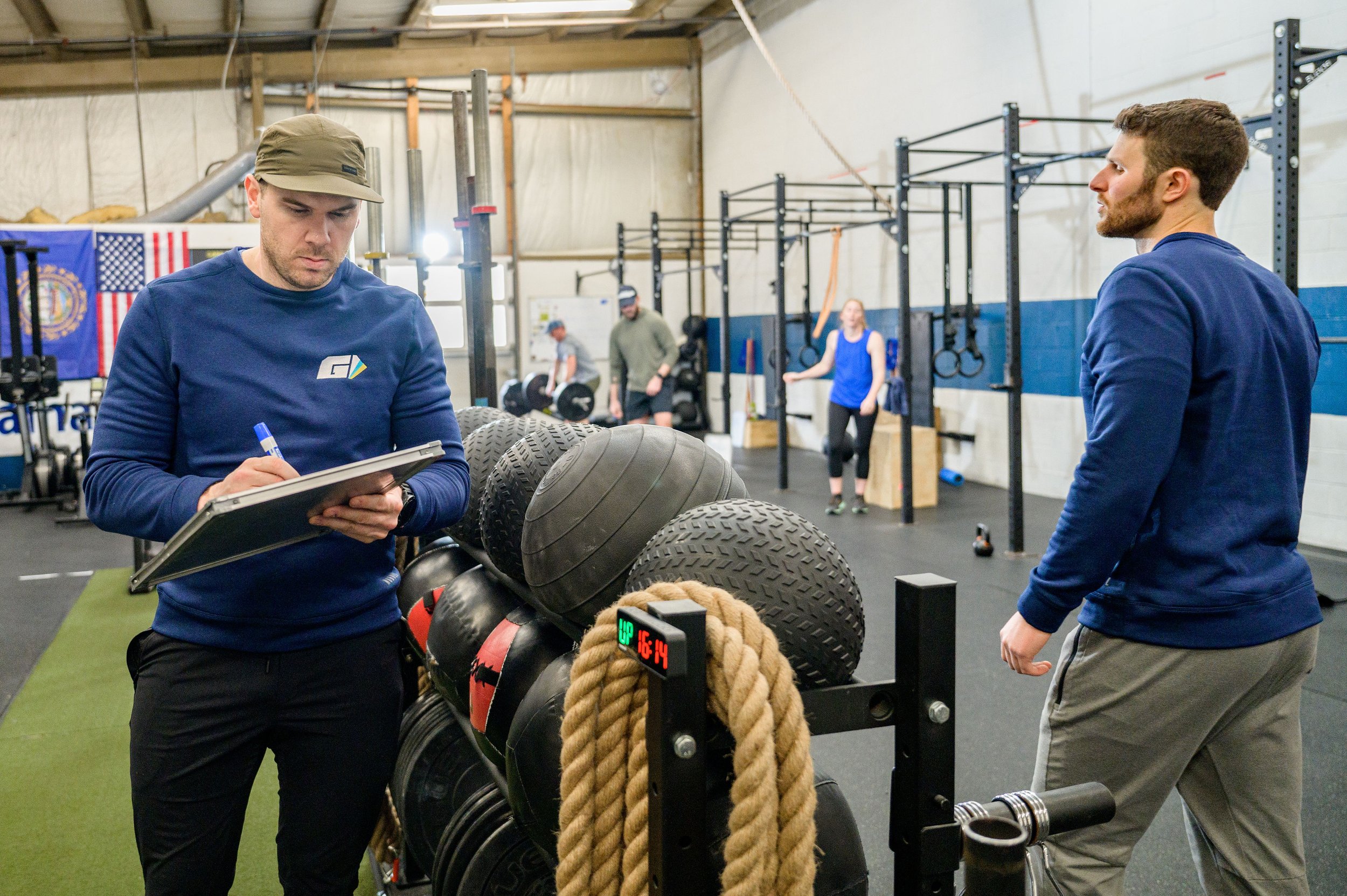
Welcome to the GAIN Blog
The blog is updated Monday-Friday. Tune in for posts and discussion about health, fitness, nutrition, training experiments and reflection. We share articles, videos and more. We post the link to our Instagram story every day, make sure to follow along there to never miss a post.
Protein
You know by now that keeping a food log is the best way to up your nutritional awareness.
If you're ready to level up again, the next piece to figure out is how much protein you're eating.
Many people are surprised at how little protein they eat once they see it quantified.
Instead of using an online calculator or doing some equation like 1g of protein for every pound of bodyweight, aim for a number slightly higher than what you're currently at. If you're only consuming 75g of protein a day, and want to be eating 125g, don't jump straight there. Hit 100g first and see how it goes.
Use these tips to make sure you're setting yourself up for protein success each day.
- Protein at every meal. No matter what.
- More eggs
- Find protein rich snacks (my go-to: grass fed beef sticks, greek yogurt and turkey+cheese roll ups)
- If you still need more, consider adding protein shake
If possible with protein powder, try a couple different kinds to see what you like and how your body reacts. You can also add it to something like oatmeal to to turn it into a meal of mostly carbs to a meal of protein and carbs.
Once you figure out a good level of protein, you can start using that as a way to create boundaries and guide your food choices.
Justin Miner
@justinminergain

Heaviest Ball in the Gym
In 2015 I learned something important about the human mind and how we create our own limitations.
Back then we had two medicine balls at the gym. An 8 pound ball and a 12 pounder.
After several months the 8 was starting to look beat up, but the 12 pounder still looked brand new. If someone was waiting for the 8 pound ball, I would suggest they try their medicine ball slams with the 12 pound ball instead.
I can't do that, they would reply, it's the heaviest ball in the gym!
So, I bought another 8 pound ball, figuring it would get used the most since our only one was already showing some wear and tear.
Fast forward and both of the 8 pound balls were wearing down and the 12 pounder was pristine.
This time, when it was time to order some new medicine balls, I bought a 20 pound and 14 pound ball.
Something funny happened.
Suddenly, the 12 pound ball was no longer the heaviest. People who wouldn't use the 12 started using the 14, since now it wasn't even close to the heaviest medicine ball in the gym.
The same thing happened with the kettlebells. No one would swing a 45 pound kettlebell when is was the heaviest one in here. But, once there were several heavier than that, more and more people started to swing the 45.
We need context for everything. Including figuring out our limitations and comfort zone.
Seeing the heaviest medicine ball in the gym can be intimidating. But it isn't intimidating when it's the second, or third heaviest.
Justin Miner
@justinminergain

Three Day Log
In one of my college nutrition courses we had to a log three days of eating as part of an assignment.
The requirements were log everything we consumed for three days and at least one of the days had to be a weekend.
We estimated portion sizes and used nutrition fact labels to calculate our total calories and macros for each of the three days. It's funny, just a relatively short time ago we didn't even have hundreds of apps to choose from to log our food intake and look up macros. We had to manually look up each food on a computer! Call me old fashioned, but I feel as though writing it down by hand gives you a better chance to reflect on what you've been eating.
Besides that, two points from this assignment have stuck with me.
First, you don’t really know what you’re consuming until you write it down. We all underestimate, or overestimate and forget about things that can add up. Running a tally in your head is helpful, but leaves opportunity for missed details.
You can imagine what a classroom full of college student's weekend food log looked like. That assignment showed me that one big off the rails day can deter progress - especially when it isn't one isolated day, but instead one (or two) days each and every week.
If you're spinning your nutritional wheels and starting to feel stuck, get out of the rut by collecting some data. Log at least three days, more would be better, and take a look at your food choices. You don't even need to log calories or macros to get started, just look at what you're consuming and see if you can make any obvious changes. You might be surprised at what you find.
Justin Miner
@justinminergain

Reasons to go to a strength and conditioning gym
Someone makes you do the hard stuff you don’t want to do.
Make the boring wok more palatable. See above.
Accountability builds consistency.
Perspective adjustments - seeing goals and challenges differently and increasing confidence.
Belong to a community with a shared goal of improving yourself.
Sometimes an easy workout is appropriate, and sometimes, you need someone to tell you that.
Warming up.
Long term development - a strength and conditioning program constantly readjusts and builds upon it set to maximize physical capacity.
Learn new skills - squatting, olympic lifting, push ups, pull ups and swings are all movement skills. Learning new skills is good for your brain.
Because no one wants to do intervals by themselves.
Foam rolling just feels better at the gym than at home, right?
Modifications. If things aren't going as planned, an experienced coach can make adjustments on the fly to elicit the desired outcome.
Shared suffering - there's something rewarding about doing hard stuff with other people.
Stick with something. Strength training is about the long game. Belonging to a gym and having a coach in your corner is imperative to keep playing.
Justin Miner
@justinminergain

Easier not Easy
A client recently went skiing for the first time in years.
I was eager to ask her how it went when I saw her a couple days later.
Not good, they reported back.
They couldn't believe how sore they were, how hard skiing was and they were so bummed that all the strength and conditioning didn't make skiing easy.
This scenario plays out often. I couldn't help but laugh.
Client trains hard, goes to do something for the first time, and they end up feeling bummed because it was hard.
This is the WRONG perspective.
My laughter was met with an angry stare, so I explained.
Imagine how much harder it would have been if you WERE NOT training so much.
Imagine what the recovery process would be like then.
And perhaps the most impactful question I raised to her; would you have even bothered trying if you hadn't been training like you have for the past 12+ months?
Instead of being bummed it was harder than she wanted (something we can't even quantify anyway), we shifted her perspective.
She had the confidence to take on the slopes even though it had been so long. She was sore, but not sore enough to stay in bed and skip a workout.
She was sore and tired from trying something new... Who cares! I'm more impressed by their confidence to get out there and do something than I am of the final results.
Training will make things easier, but not easy. Don't forget that perspective as you start pushing your own limits.
Justin Miner
@justinminergain
Components of a Strength and Conditioning Program
Strength - Adaptation intended to improve force production. Usually between 2-8 reps, or 20-30 total repetitions. Rest 90 sec- 3 min between sets. Aim for the last two reps of your set to be challenging to get the most strength gains.
Power - A strength display with speed! Power is about generating as much speed in as little time. Power training comes in many contexts, medicine balls, olympic lifts, jumping and we can even focus on it with a barbell or kettlebell. We aim for 2-5 reps and multiple sets at the same intensity, i.e., don't slow down.
Hypertrophy - Muscle building sets. Higher rep ranges between 8-12 reps. We like these sets for joint and tendon health and getting the blood pumping. Less rest is required here compared to strength sets.
Muscular Endurance - Even higher rep ranges, 12+. Does what it sounds like, improves the ability for your muscles to keep doing the same thing. We'll expose you to high rep ranges like this within the context of conditioning with little to no rest.
Accessory/Assistance - Not necessarily something we need to strive for load/rep progression. Often times it is an exercise to help a main strength lift, like doing some DB floor presses after benching. Of course, this means accessory work is ALSO hypertrophy and/or muscular endurance, and/or even strength.
There is no clean line between these different rep ranges - the training effect will blur between them.
Skill - A component of all the above. Movement and awareness of your body is a skill. Specific technique of each exercise is a skill. Showing up to the gym and training consistently is a skill. Strength and conditioning gyms are skill factories, and if you learn how to learn new skills, you'll be unstoppable.
Mobility - You have the requisite range of motion to do something, which is how we define flexibility, and you also have the stability to display control there. Consistent exposure to valuable positions is the best way to improve mobility.
Conditioning - Creating adaptations using specific metabolic pathways intended to improve endurance and stamina at both moderate to low intensities and very high intensities.
Justin Miner
@justinminergain

Night Time Wind Down
I'm on a hot streak with my training, and have been for a while. In fact, I can quantify it; I've trained 89 times in the past 81 days.
There are a lot of factors playing into my streak.
Besides the new found discipline from becoming a father, I've redefined what I deem a successful workout doing (very) short sessions - really hammering the minimum effective dose idea. There's something else that deserves a lot of credit, and it starts with the night before.
I've written before about how doing the dishes at night got me started training early in the morning, but there's something else I've been doing after the dishes, and I'm here to tell you it makes all the difference between a productive day of training or going through the motions.
I warm up.
Not in the sense that I get sweaty, and start bouncing around and getting amped to train. The opposite in fact.
I do any soft tissue/mobility/restorative work in anticipation of what I'm going to do the next day. Planning on some pull ups, I'll spend a few minutes working on my forearms, elbows and lats. Deadlift session? I'll open up my hips and hamstrings. For running intervals, I'll give my calves some love and hang in the couch stretch.
This accomplishes a couple things. 1. It gets me mentally prepared for tomorrow's training and helps when I'm tired and don't feel like going into the cold garage at 5am, 2. It saves me from doing those things in the morning! Instead of rolling and stretching in the morning, I focus on getting sweaty and getting started.
If you're looking for a secret weapon to get more from your training, I can't recommend enough that you get on the floor and get some quality work in the night before.
Justin Miner
@justinminergain

Strength and Conditioning Can Help You:
Pick up grandkids
Feel athletic
Get into a routine
Start a new lifestyle
Get stronger
Do good push ups
Build confidence
Become healthier
Rebuild an injured area
Go skiing
Have more energy
Learn how to use barbells
Upgrade your cardio
Get better at running
Go for a long hike
Improve mobility
Have a baby
Gain muscle
Reverse bone loss
Be powerful
Climb the rope
Do pull ups and box jumps
Improve balance
Handle heavy grocery bags
Belong to a community
Justin Miner
@justinminergain

Intervals, Some Examples
I love intervals. They're a fantastic way to upgrade your cardio routine. You'll get a better training effect from intervals opposed to steady state conditioning. Which does have its place, but won't be the focus of this post.
Here are a some of our go-to interval protocols, how you should feel and what we're trying to accomplish.
10 sec FAST / 50 sec EASY
Feel: Lung burner. Ten seconds is short, but you should be gasping for air by the end of the round. Push the pace past your comfort zone and hang on. During the easy, take it nice and slow and work on regulating your breathing.
Goal: Increasing high intensity time. By working really hard for that short burst, we're trying to improve our anaerobic energy system and get comfortable working at high outputs.
2 min FAST / 1 min EASY
Feel: Pacing. Twice as long on the on interval will force you to pace yourself. The short rest will limit how hard you can go. Aim for being able to speak a couple words at a time, maybe 6/10 effort. If you can speak in full sentences, you need to dig a little deeper.
Goal: Aerobic capacity. By working at a slightly faster than normal pace with a short rest, we're challenging your aerobic system. Imagine you do a 10 minute AirBike time trial and get 5500m. Let's say you're doing 5x2min/1min. That's 10 minutes of "work." Ideally, since you have the rest in-between, you will get further than 5500m if you add up your work intervals.
30 sec FAST / 30 sec SLOW
Feel: Sustainable. When doing 30/30's, you should feel in control the whole time. Keep in mind, everyone's fitness levels are different, but for the most part, 30/30's are a nice introduction to interval training. We want to elevate the heart rate/breathing just a bit during the ON, and work easy enough that we can down regulate during the slow 30 seconds.
Goal: Ease into longer conditioning sessions. For some, 10 minutes steady is too much at first, and this is a good way to build up to more intense interval options. For a more trained endurance athlete, this protocol serves as a nice low intensity interval, fluctuating your heart rate slightly without letting it get too high.
This scratches the surface of some intervals we use @gain_sc. I hope this gives you an idea of how each protocol should feel so you can get the most from your training.
Justin Miner
@justinminergain

Counting!
A sneaky high level strength and conditioning skill is counting your reps.
There are a lot of things to think of all at once. Screwing your feet to the floor, squeezing your butt, the weird exercise names, keeping your core engaged and on top of all that, you need to remember to breathe.
At first glance counting seems like just another annoying thing to occupy your mind. It isn't. In fact, not only will it make sure you get the proper dosage of reps, it'll actually help you do all those other things, too.
Counting forces you to be engaged. Ticking off each rep, 1,2,3,4... gives you an opportunity to check in on your form, and make sure you're doing all the aforementioned things like breathing and squeezing your butt. Each time you count, remind yourself to breathe, or squeeze or get your elbows up, or whatever the thing may be.
Like I mentioned, counting is high level. But don't just count, use counting as an opportunity to clean up your movement and be more engaged on with what you're doing.
Justin Miner
@justinminergain

Horizontal Pulling - An Unsung Hero
Horizontal pulling, or rowing, is the unsung hero of strength and conditioning. Deadlifts, squats, and its vertical pulling counterpart, the pull up, get all the glory.
Rowing variations support these iconic movements through building upper back strength, creating healthy shoulders and improving posture.
Whatever you're rowing, be it rings, a dumbbell, kettlebells, a barbell or even a band, keep these things in mind.
Squeeze! Squeeze the handle with your whole hand. Don't let it hang in your fingers.
Don't shrug. Keep those shoulders away from your ears!
Use your upper back, not just your arms. Slide those shoulder blades across your back.
Keep your hips square (especially with single arm pulling)
Most importantly, don't forget that all those ring rows, dumbbell rows and bent over rows are part of a well-rounded program and play an important role in busting PRs in the more glamorous lifts.
Justin Miner
@justinminergain

Defining Confidence
At Gain we help people feel strong, confident and independent.
The most important word there is confidence. Without that, the other words don't mean nearly as much.
We define having confidence as knowing you're capable of your best effort regardless of the circumstances.
Strength and conditioning teaches you to trust your body. You learn its limits by touching the edge with good training.
Controlled exposure of adversity, problem solving and uncertainty in the gym creates the opportunity for you to give your best away from the gym.
Life might not look like deadlifts, AirBike sprints and lunges, but knowing you're capable of those things will allow you give your best effort on any task you desire.
Justin Miner
@justinminergain

Infinite Game
There is no winning fitness.
There will be no moment of arrival.
There won't be a point you can stop.
You just need to keep playing.
Chess, hockey and football are all finite games. They have rules. A start and an end. Clear winners and losers.
In fitness, business and life, however, there are no rules. There is no clear finish line.
You can keep playing though. And that's how you win; staying in the game.
But what about the races I train for? What about my goal to lose 10 pounds? What about my Whole 30?
"Finite games can be played within an infinite game, but an infinite game cannot be played within a finite game. Infinite players regard their wins and losses in whatever finite games they play as but moments in continuing play."
- James P. Carse, Finite and Infinite Games
You've got to play the long game. It's the only way to be successful and keep playing. Maybe it looks different over time, or you have different goals [finite games] that motivate you and get you in the door. But the game is always there. There's no destination.
I hope this perspective doesn't overwhelm you. Instead, I hope it brings you relief. There is no rush. No need to hurry to the finish line. To end on a cliche, it's the journey not the destination. Keep yourself in play.
Justin Miner
@justinminergain

Muscle Contractions
Imagine yourself in the gym squatting. Not just that, you have to lower the weight down for 3 seconds, pause for 3 sec on the bottom, try to explode out of the hole, and then pause at the top for 1 sec.
We call that a 33X1 tempo. Each character corresponds to a specific task our muscles are performing. Tempos use muscle contractions to elicit a better training effect.
There are 3 types of muscles contractions, and we use them all when we're navigating life and training.
Concentric
When the muscles shorten under load. Standing up from a squat or pushing from the bottom of a push up. For a dumbbell row, the concentric contraction happens as you bring the DB towards your torso, since the muscles are shortening to get it there.
Eccentric
When the muscles are lengthening under load. Lowering portion of squat, bringing a barbell down to your chest on a bench press, and lowering a pull up are all eccentric contractions. We're typically stronger during the eccentric phase than concentric. If you've ever gotten pinned by a bench press after lowering the bar down, but just didn't have any juice to get it up, that's why.
Isometric
During an isometric contraction the force produced by the muscles is equal to the load, so nothing moves. Iso holds work on strength in a specific range of motion and stability.
Back to our 33X1 squat example.
The first number is the eccentric portion. Three sec to lower. This allows us to build in more time under load. Since you're stronger with eccentric contractions, we can drag them out to promote muscle growth and strength adaptations.
The next 3 sec is an isometric hold. After lowering the weight, you'll pause, maintaining that contraction for 3 sec. This gives you a chance to work on range of motion by maintaining proper position on the bottom and will further challenge your strength.
The X part is our concentric contraction. During this muscle shortening phase, we want to try to move as explosively as possible. This will ensure we are recruiting many muscle fibers, and therefore will reinforce strength gains.
The final number is simply an isometric hold at the top portion of the lift. It's rare this number is more than a 1.
Justin Miner
@justinminergain
