
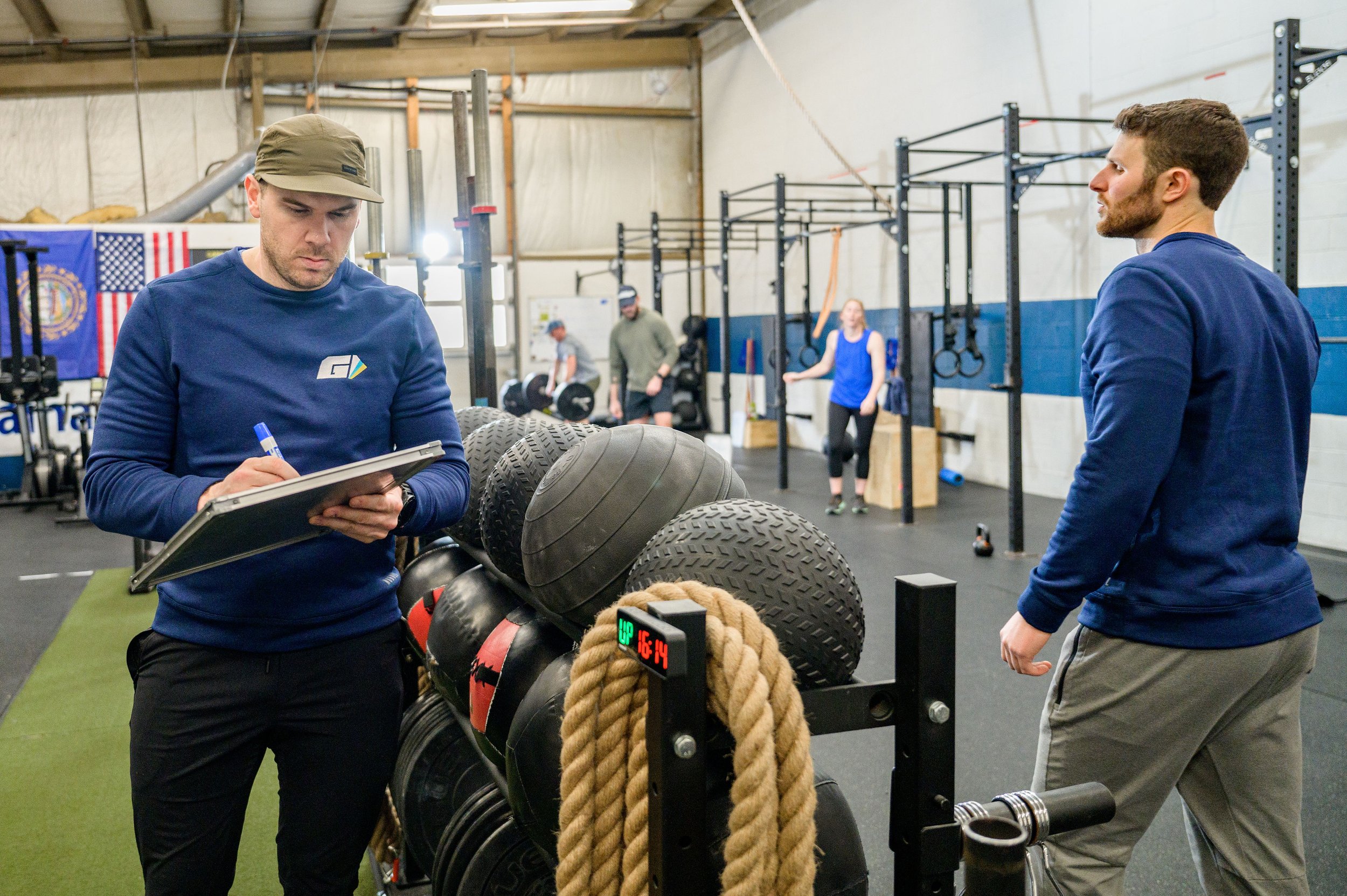
Welcome to the GAIN Blog
The blog is updated Monday-Friday. Tune in for posts and discussion about health, fitness, nutrition, training experiments and reflection. We share articles, videos and more. We post the link to our Instagram story every day, make sure to follow along there to never miss a post.
Gym Lingo: Sustainable Pace
Complete the intervals at a pace that you can repeat each set. In other words, don’t come out too fast and conditioning yourself to get slower and slower.
This is endurance training in a nutshell. And a mistake even experienced athletes frequently make.
I see it in races all the time. On the first couple miles it’s easy to get thrown off your plan when everyone else comes out sprinting. If you get caught up in that, you’ll fizzle out too. If you run your race, you’ll pass all those people in a couple more miles.
Ease in, feel it out, and on your first interval, consider how you’re going to feel on the 8th round.
Avoid the trap and find that sustainable, repeatable pace. Just by doing that, your endurance will improve.
—Justin Miner
October by the Numbers
Welcome to this month’s edition of By The Numbers, where I break down data from my watch and training log to reflect on the past month. I track metrics like average sleep, daily steps, and total workouts. I’ve been doing this monthly for two years now, and it’s proven to be a valuable tool for spotting trends, holding myself accountable, and fine-tuning habits. I highly recommend building a habit like this into your own routine.
Let’s get into it.
STEPS
Total: 357,477
Daily Average: 11,531
This was higher than expected—which was a nice surprise. The day I ran a half marathon, I logged over 30,000 steps, my highest day of the month. The lowest was a Sunday, with fewer than 7,000 steps.
Walking to the bus stop every day has made a noticeable difference in my totals, even though it’s a very short walk. But very short × twice a day × five days a week adds up to a lot of “extra” steps.
SLEEP
Average Score: 78
Average Sleep: 7 hours
Not a bad month in the sleep department. I wrote a lot about August and September—they were rough, and I wasn’t sleeping well. I was feeling its effects.
What’s interesting, and something I just realized while writing this, is that my average sleep score has basically been the same all year.
On one hand, that’s frustrating. I’ve been limiting caffeine, going to bed earlier, and making a real effort to get good rest. However, even though the number hasn’t changed—I know I feel better.
And that’s the dilemma with fitness trackers. I’m sure one day I’ll retire my Garmin and go back to a Casio like a proper old-school runner. But until then, I’m addicted to the data. I want to see what it does—even if that’s seemingly nothing.
Another note: I’ve always thought my watch overestimates “awake time” overnight. I’ve been paying close attention, and I regularly get up to an hour of recorded awake time—even on nights I never wake up and feel completely refreshed. Maybe it’s a limitation of the tracking tech? Because if I sleep for eight hours, my watch might credit me for 6:45 with 75 minutes awake.
Lastly, HRV. My HRV has been solid this month, back near baseline. Maybe this number is a better indicator of recovery, though there are still days when it’s low and I feel great anyway.
Bottom line: use this info to calibrate yourself and audit how you actually feel. Don’t rely on the data to tell you how you feel.
WORKOUTS
Total Workouts: 20
Run/Conditioning: 10
Lift: 10
Nice to see an even split between lifting and running. I raced twice—Vulcan’s Fury Trail Half Marathon and the Great Bay 5K—and all my other runs were easy trail sessions, 45–60 minutes each.
I deadlifted and bench-pressed most weeks, took on the GAIN October Challenge (finished 4th place), and got reacquainted with the AirBike.
Thanks for reading along. As always, I encourage you to build a monthly reflection practice like this. It’s one of the simplest ways to keep your health, fitness, and daily habits moving in the right direction.
—Justin Miner
Monday Check In
Was yesterday the longest day ever, or is it just me?
Falling back the clocks is always strange. On one hand, it’s only an hour—how sensitive can we really be? But on the other, that single hour can throw off your body’s entire rhythm. By 7:00 p.m. last night, I was ready for bed.
My sleep score, HRV, and resting heart rate stayed normal, but I’ll be keeping an eye on them this week to see if anything shifts.
Have a great start to the week, I’ll see you in the gym!
—Justin Miner
Friday Thoughts 103
thief of joy
Is comparison really the thief of joy?
A couple people mentioned this week that they were surprised to hear me comparing myself to my past self — especially since I’ve told them not to do that over the years. Fair point.
If you did the Fast Mile Project this summer, you probably remember me saying not to compare your current self to your lifetime mile PR — especially if that came 15 or 20 years ago, when you were in middle school and running on pure adrenaline and youth.
Back in 2019, I was at my all-time highest running volume. I was fit, light, and hit a few PRs — including the mile and 5K. Since then, I’ve focused more on getting stronger, building muscle, and maintaining enough cardiovascular fitness to hang on when needed.
In 2024, I ramped the running back up. I did some cool stuff — like pacing 50 miles at Wasatch — but I never felt my fittest or fastest. I had the volume, but not the confidence. My ability to put the hammer down was fading.
Fast-forward to summer 2025 and the Fast Mile Project. I removed the pressure and told myself: just train, and see if you can run a fast mile again. My stretch goal was to beat my old time but I didn’t know if it was realistic. I’m heavier, older, busier, and, honestly, not as willing to suffer as I used to be.
Still, after seven weeks of focused training, I ran a 5:30.5 mile — matching my all-time best.
And that’s when the 5K chatter started.
Can I go sub-20? If I can run a mile that fast, shouldn’t I be able to? What about doing it at 100 kilos?
So — should you compare yourself to your former self?
Yes, absolutely. But do it wisely.
Have the right parameters and metrics.
Daydreaming about something you used to do isn’t the same as pursuing a goal grounded in data, context, and discipline.
I had numbers. I had a realistic time frame. I had years of consistent training behind me with no injuries. And I have the discipline to see it through.
Comparison can help us gauge progress — but only if we’re honest about where we are now.
If you’re going to compare yourself to a younger version of you, make sure you’re using the right data, setting realistic expectations, and preparing yourself for results you might not love.
N = 1
One of the best classes I took in college was Research Methods. It taught us how to conduct formal scientific research and culminated in a published study on the post-activation potentiation of a heavy sled push paired with a sprint. Pretty cool stuff.
One of the main takeaways from that class was the importance of having a high number of participants — at least 25. The idea is simple: the more subjects you have, the more data you can analyze to see how your intervention truly affects people. In research, n stands for the number of participants. In that study, n = 25.
My running example above, however, was an n = 1. I was the only participant in the experiment. And while my research methods professor would probably say that’s not enough to draw any statistically significant conclusions, I’d argue that an n = 1 experiment is one of the best ways to improve your health and fitness.
It’s a personal experiment — where you become both the researcher and the subject — and you get to test a hypothesis on yourself.
How to Run an N = 1 Experiment
Define the question or hypothesis.
Example: “Does taking magnesium glycinate before bed improve my sleep quality?”Set a measurable outcome.
Sleep score, resting HR, HRV, time awake, or subjective energy — anything quantifiable.Control the variables.
Keep other factors like caffeine, bedtime, and workouts as consistent as possible.Run a baseline period.
Track your metric for 1–2 weeks without the intervention.Add the variable.
Introduce magnesium and continue tracking under the same conditions.Compare.
Look for consistent changes relative to baseline — ideally using averages, not single days.Repeat or remove.
Remove the variable and see if things return to baseline. That’s your confirmation.
You don’t need a lab coat or a research grant to learn from your own data.
All you need is curiosity, consistency, and a willingness to experiment on yourself.
Check Engine Light
If the topics above are to your fancy, listen to this podcast, The Ready State Podcast with Rob Wilson.
I met Rob at a breath work seminar in 2018 at his gym in Virginia Beach. Andrew Huberman was there—pre podcast and fame—as a participant, and did a short post-seminar presentation for anyone who wanted to hang out. It was pretty cool. Anyway, the Starretts just had Rob Wilson on their podcast, and they talk about his coaching and his new book the Check Engine Light.
It’s a great chat about getting in tune with your own body, problem solving and feeling good. There’s a good discussion about HRV scores, something that’s been a bit of a hot topic at the gym lately.
You can listen on Spotify by clicking this HERE
Thanks for reading, see you next time!
—Justin Miner
Your Next Position
I was recently flipping through my copy of The Trigger Point Therapy Workbook recently. It’s full of different techniques to self-mobilize your soft tissue, something we do at the gym everyday with foam rollers, lacrosse balls and the like. It’s an old book, so it’s a little dated, but there are some valuable takeaways nonetheless.
I was flipping through and this passage caught my eye:
“Staying in any position too long, even a comfortable position, is hazardous to muscles. A static position favors the formation of trigger points because it hampers circulation. Muscles need a certain amount of contracting and relaxing to stay healthy. Many jobs are static by nature, particularly anything done sitting at a desk. Unfortunately, sedentary or inactive work gives you the impression that your work is easy, that you’re not straining anything. On the contrary, you might be well under a great deal of subtle physical stain and not recognize it.”
Remember, posture is just a word or what position you’re in, and your best position is your next position, because the more you can move, the better. Avoid static positions and try to move frequently. Take breaks and instead of searching for the most perfect set up, try a variety of positions throughout the day to expose your tissues to many different stimulus.
Justin Miner
@justinminergain
The Perfect Program
As an exercise science major, a majority of my classes were focused on program design and exercise selection.
How could you maximize perform outcomes by controlling the variables you could control. I loved it.
We learned about what exercises paired with each and other and which pairings to avoid, how to order exercises, proper rest period timing and building macro and microcycles. Using that knowledge and a little bit of creativity, you can create a training program. It was really clear to me; if you weren’t strictly following a perfectly designed training program, you were just wasting time in the gym.
At the time I was playing hockey and I trained to get better on the ice. One summer, I became obsessed with having the perfect program, it killed all of my progress.
If I missed a day or two, I would throw away a whole week to start fresh on Monday. Eventually, this led to program hopping - I’m not making progress on this plan, I’ll create a new one! And the cycle would start over. Eventually I stopped trying at all.
Of course, it wasn’t the plan’s fault. It was my inability to stick with it. Or rather, my inability to get back on the horse. To just keep going with pretty good rather than thinking I needed perfection.
That summer was crazy. I was working full time as an ice truck driver, taking a college class, interning at a gym and training for the upcoming hockey season.
Trying to be perfect halted any progress I could have made. Instead of starting the program over and over again, I should have just kept going, even with some missed days. Sure, the plan wouldn’t be perfect or ideal, but the benefits of doing something far outweigh what you get with nothing.
Justin Miner
Great Bay 5k Recap
I didn’t want to do this race. I spent all day Friday thinking of excuses, and Saturday morning was no different. My goal was to run under 20 minutes, and that pressure made the idea of racing feel more stressful than fun. I procrastinated, delayed, and finally—after eating my usual breakfast sandwich—I got out the door.
With a short race like a 5K and a cold morning in the 40s, the warm-up is crucial. Luckily, I parked far away. I opted for short sleeves (the right call) and wore gloves for the warm-up. For the record—short sleeves and gloves is an elite running combo.
At the start line, I knew what I needed: a 6:25/mile average to break 20 minutes. If I executed well, each mile would get just a touch faster. The field was big, so I focused on running my own race. When we hit the 1-mile marker, I rounded a corner and saw the clock—6:26. Perfect.
That first mile felt smooth, and now it was just about hanging on. I tried to pick things up slightly for mile two. Whenever my form started to fall apart, I zeroed in on cadence and mechanical efficiency. Just after mile two comes a small climb before the long downhill finish. I worked that hill, made a few passes, and then opened up the stride coming down to the finish.
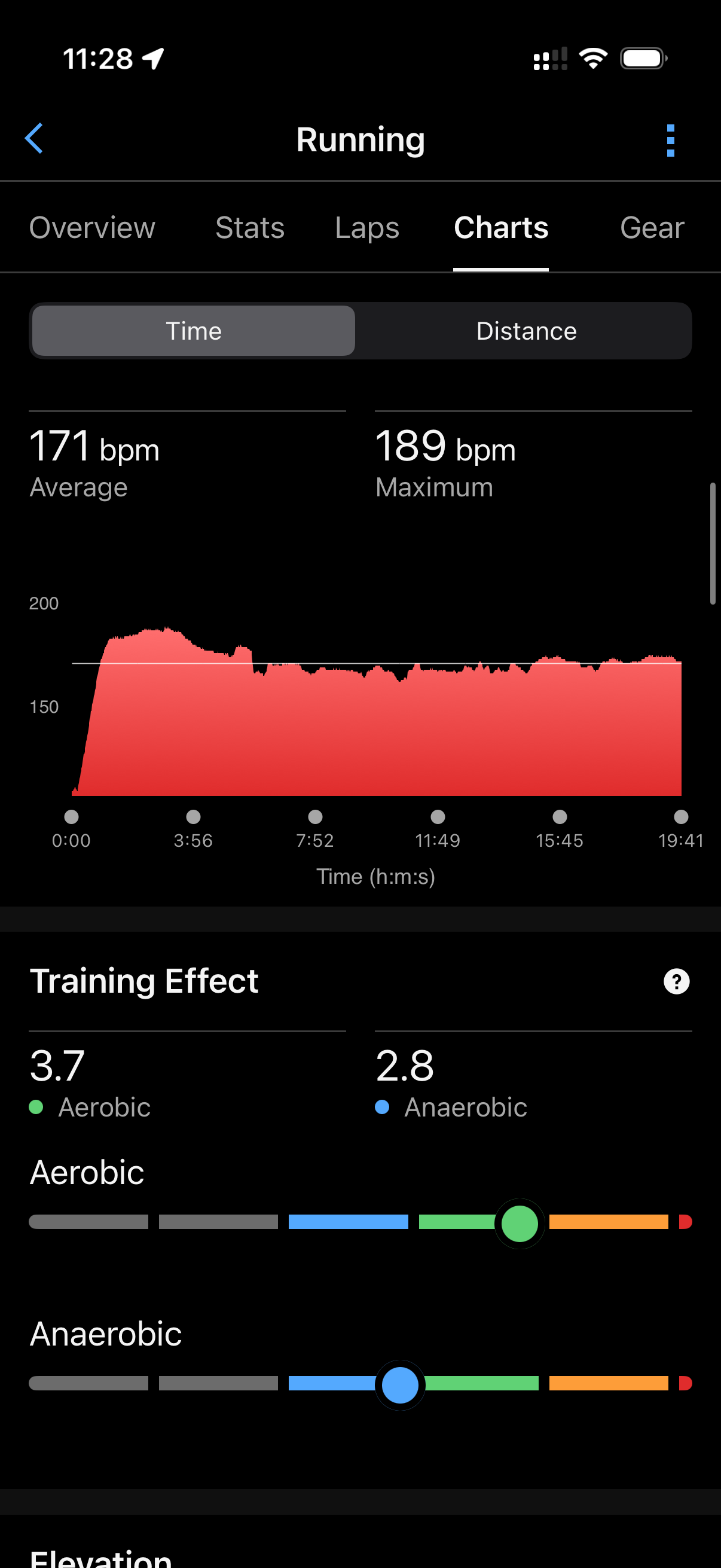
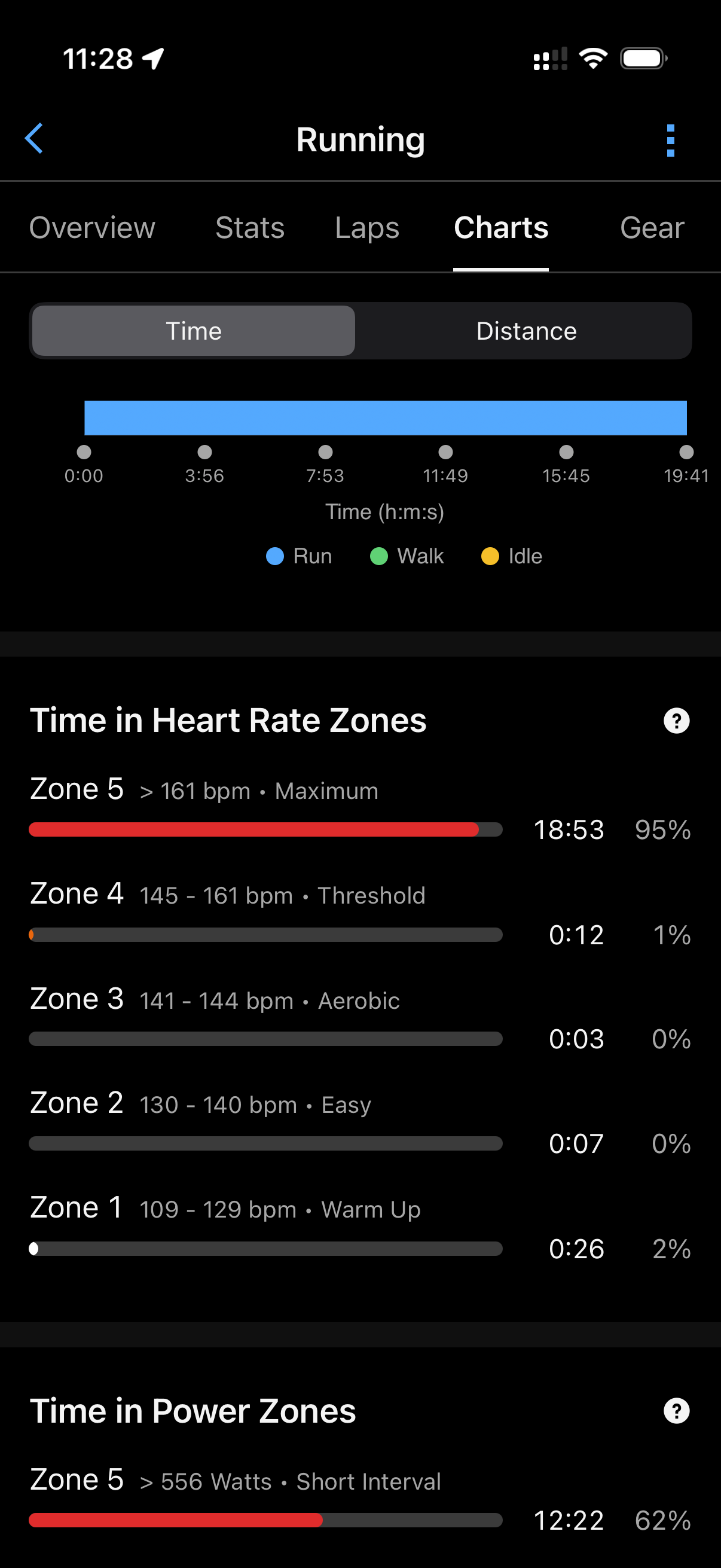
Final time: 19:42.
This year has been a quiet battle with my 2019 self—am I fitter now or then? Better at training? Stronger, even with more life on my plate? After running a 5:30 mile and now a 19:42 5K, I can confidently say: it’s working.
Enjoy some of the data below, and here’s to no more races on the calendar this year.



—Justin Miner
Monday Check In
I’m sure you’re keeping track, today marks 300 days into year. Just 65 days left until we’re in 2026.
That means there’s just 9 more Monday Check Ins, 9 more chances to get a week started off on the right foot.
Of course you’ll have plenty of chances to do that in 2026, too. To me, the end of the year is motivating. A chance to carry some momentum, habits and routines into the New Year.
Whether you’re day dreaming about the New Year, or trying to get your stuff together for this upcoming week—be sure to take a few minutes and get yourself organized. What are your goals this week? What do you need to get done? Are your prioritizing time for yourself?
See you in the gym!
—Justin Miner
Friday Thoughts 102
Welcome to this week’s edition of Friday Thoughts, where I share what’s been on my mind and in my feed this week. Let’s get into it.
Big’s Backyard Ultra
The original backyard ultra went down last week (and this week) as it always does in Tennessee. This years winner, Phil Gore ran 475 (not a typo) miles over 113 hours — that’s 4.2 miles every hour on the hour until no one is left. What’s more impressive than the nearly 500 miles is the crazy sleep deprivation is takes to pull something like this.
Great Bay 5k
Last race of the year is tomorrow—the Great Bay 5k—starting at Stratham Hill Park and running down to the Great Bay Discovery Center. I’m nervous for the pain and anxious to get it over with!
Kettlebell History Lesson
This was informative about the history and origination of the kettlebell.
Eye of the World
I’ve been nervous to read Robert Jordan’s Wheel of Time Series because it’s just expansive—14 books! I finally cracked open book 1, the Eye of the World, and while it’s still early on I think I’m already hooked.
See you in the gym!
—Justin Miner
Balance, Agility and Coordination
There’s a great book called Balance is Power by Jim Klopman.
If you’ve seen those little blue balance blocks in the gym, they’re called Slack Blocks and he created them.
Here, he defines agility:
Agility is the ability to control and operate one’s body at high speed, under stress and in space.
Coordination, on the other hand:
Coordination is a component of agility. Coordination zeros in body control.
Klopman’s point is that you need to be coordinated to have the best agility and that the two are related to one another. Therefore, balance is the sum of coordination and agility, as represented in this equation.
Balance = coordination + agility
When an athlete improves their balance, they improve their coordination and agility as a result.
Not many people come into the gym considering agility a trait they need to improve, but from this perspective, it’s a key component to having a robust body.
Justin Miner
Color coodinated
Do you know why all the kettlebells in the gym are color coordinated? Sure, it keeps things organized—but there’s another reason, too.
When I first started coaching, I primarily worked with middle school and high school athletes. One of my most memorable groups was a varsity girls’ soccer team. Many of them had the talent and drive to play in college, and they needed to get stronger.
At that time, it was the Wild West of kettlebells. You couldn’t just buy a full set at Target or online, and if you managed to track down a mail-order catalog, you’d pay a ridiculous price. Basically, if you had a chance to buy a kettlebell, you took it.
That meant the gym’s collection was a mismatched mess—different sizes, diameters, colors, and markings. Most were labeled only in kilograms, others had pounds stamped somewhere hard to read.
Because of that, I would hand out kettlebells for each session so everyone got the right weight. Since the bells were so inconsistent, and no one could easily tell what they weighed, the athletes simply squatted whatever was in front of them.
After a few weeks, I noticed something interesting: the girls were progressing on their goblet squats but not their trap-bar deadlifts. I couldn’t figure out why—until it hit me.
With the deadlifts, they loaded their own bars, and it’s very clear how much a 45-pound plate weighs. When they knew the number, it made them nervous. When they didn’t, they just lifted.
Once I realized that, I did two things: I went to the hardware store, bought a bunch of spray paint, and spent the afternoon color-coding the kettlebells by weight. Then, during future sessions, I’d simply tell them, “Grab the yellow,” or “Grab the blue.”
I also started loading the trap bars myself. Only after a successful lift would I tell them how much was on the bar.
That simple shift taught me an important coaching lesson:
Numbers can be intimidating. Seeing them can make people think, I’m not strong enough for that or That’s too heavy—I’ll get hurt.
So the color-coordinated kettlebells stuck around. Now, when new clients start training, I tell them not to worry about the pounds—just think of it as the orange or blue or yellow kettlebell.
That subtle mindset shift can unlock even more strength gains.
—Justin Miner
Aerobic Base Building
This video by running coach Steve Magness is outstanding. It’s about how to build your aerobic base.
The videos geeks out a bit about mechanisms that drive your aerobic system, but what I loved was the big takeaway.
In order to improve your aerobic system you need many different inputs, of varying intensities and volume and, in the right doses.
While that sounds like a vague protocol, my main takeaway was, it depends!
It depends on the person, goals, training, history, schedule and so many other factors.
My other takeaway: a lot of stuff works. There is no perfect protocol.
Enjoy the video and let me know if you watch it.
—Justin Miner
Monday Check in
Happy Monday! Time to start another week.
All summer I was locked into training. I would plan my days around my runs. I would get up early, do double sessions, and plan all my meals around recovering from my run.
Now, training is on the back burner…and it’s nice.
It’s hard to stay “on,” all the time, and while I’m still training most days, it feels less burdensome and more enjoyable.
Phases like this, and developing this mindset, are important to stay in the game.
In a month or two I’ll be ready to turn it on for something, but in the meantime, I’m going to enjoy this phase of working out instead of training.
—Justin Miner
Friday Thoughts 101
Welcome to this week’s edition of Friday Thoughts, let’s get into it.
HRV TRend
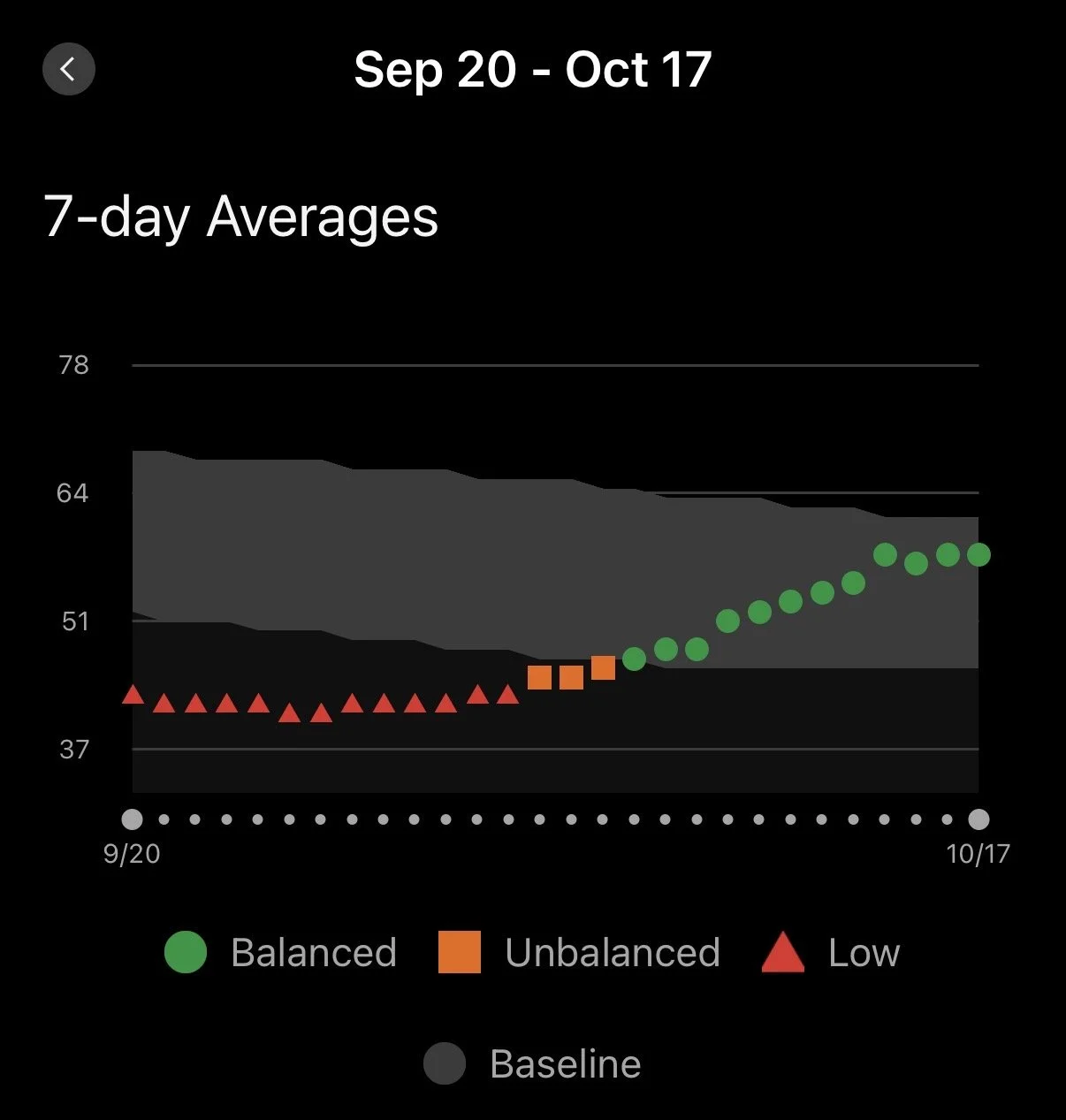
I’m happy to report my HRV has been trending in the right direction. As it gets settled within the baseline, my resting heart rate has finally dropped into its normal range too. This was a long ordeal. So long you can see my baseline even shifted down slightly.
October Challenge
This month’s challenge workout is a doozy. Most people—even amongst the fire breathers of GAIN—won’t be able to finish it. It’s just a lot of reps, in a short period of time with heavy dumbbells. I thought my score of 8:41 would have held up against everyone, until Nate Kingsley visited. Nate beat me by more than a minute in an impressive display of benching prowess. He made the 50 pound dumbbells look like toys. Impressive effort Nate!
Here’s the workout:
3 Rounds for Time:
500m c2 bike
25 db bench press @ 50s/25s
250m row
11-minute time cap
Cold Running
I had a hard time figuring out my layering on yesterday’s run. It was in the low 50s, but with very strong winds. It was nice in the sun, but in the shade of the trees with the wind whipping it was much colder. I opted for shorts and a light windbreaker with a hood. As I walked away from the truck I grabbed gloves too, and took them off about 1 minute later when I started climbing up the hill. I felt out of practice layering and it made me miss running in the long days of summer.
That’s it for this week. Have a good one!
—Justin Miner
One Year Later
We’ve been reflecting on last year’s October Habit Challenge—and where we are now, a year later.
To refresh your memory, last October we picked one habit to stick with every day for the month. Some people read for 10 minutes, some journaled, others focused on eating without distractions or hitting a daily walking goal.
Whether you participated or not, take a minute today to look back on something you tried or started a year ago.
How’s it going now?
Are you still doing it, or did it fade away?
Either way, the reflection is a worthy check in.
—Justin Miner
When to Train Barefoot
If you want strong, resilient feet, one of the best things you can do is spend more time barefoot.
Without shoes, your balance changes and you feel more connected to the ground. The muscles, tendons, and ligaments in your feet and lower legs get a chance to do their job and strengthen naturally.
When should you ditch the shoes?
Whenever you can.
Warm-ups and cooldowns are a great place to start. But any exercise where your feet stay planted on the floor is fair game.
Barefoot jump rope? Bad idea.
Barefoot deadlifts? Good idea.
Squats and most single-leg movements are perfect opportunities too.
If you want strong, healthy feet — get those shoes off and get to work.
—Justin Miner
Vulcan’s Fury Half recap
On Sunday, I headed to Pawtuckaway State Park for the Vulcan’s Fury Half Marathon—about 14 miles and 2,300 feet of gain across some rugged New Hampshire trails. That place is massive, and it was fun to get back out there.
This has been the year of shorter trail races for me: Sunapee Scramble (9 miles), Loon Mountain Race (6 miles), and now Vulcan’s Fury. I’ve really enjoyed these distances—they let you open it up without worrying about saving your legs for a full day.
Heading into this one, I wasn’t sure how I’d do—or even if I’d show up. September was lackluster, and early October wasn’t looking much better. The added pressure: trying to beat my 2019 time.
I kept my watch simple: elapsed time, pace, and heart rate. I don’t usually monitor HR during races, but it helped this time, especially on the early climbs. I let people pass me, knowing I had to run my race. On the descents, I made sure my pace stayed well under my goal average of 10:30/mile. I broke the race into three sections between aid stations and never looked at miles.
Around halfway is my favorite part—the climb up North Mountain through wide open woods and massive boulders, followed by a wild, steep descent off the ridge. It’s a brutal section, but I bombed down it feeling smooth and confident. In 2018 and 2019 it wrecked me, but this time I stayed in control. You’ve got to trust every step.
After one more big climb, it was mostly steady running to the finish. I fueled with three maple syrup packs and a quick swig of Coke at the mile 10 aid station. My energy dipped late, but I kept moving, trying to stay quick through the rolling singletrack. I carried a small water bottle—wasn’t sure if I’d regret it, but on that mid-race climb, I was very glad to have it.
What I was happiest about was how my legs held up. I pushed the descents, climbed strong, and still had enough to keep running the flats. Climbing gets all the attention, but in trail racing—especially these shorter ones—it’s really your downhill speed that determines your result.
Even though it was my slowest Vulcan’s Fury yet, I’m proud of it. 2019 Justin was fast—about ten minutes faster, actually—but this version of me feels fitter and less wrecked from the effort. The season’s been full of “then vs. now” comparisons, and while I didn’t beat my old time, I think I’m stronger and more durable.
Next up: the Great Bay 5K, October 25th!
—Justin Miner
Half the cheer squad
Monday Check In
Another Monday, another week!
The gym is open normal hours today.
Whether you’re working today or not, getting a workout in will kickstart a week full of good habits.
Make sure to get it in!
See you at the gym.
—Justin Miner
Friday tHoughts 100
Welcome to this week’s edition of Friday Thoughts, triple digits! As always these are the things that have been on my mind and in my feed this week. Enjoy!
HRV IS BACK
Back in the green! It’s taken a long time to climb out of this not-recovering hole. I first dropped into the red on August 7th, so almost two months. I’ve been focusing on the basic sleep habits—getting into bed early, limiting caffeine intake (how much and when), and trying to get some movement in most days.
Going forward, it will be interesting how see if this low period is part of my yearly training cycle, or if this was just a big fluke. I guess only time will tell!
Vulcan’s Fury
On Sunday I’m heading to Pawtuckaway State Park for the Vulcan’s Fury Half Marathon. I’ve done the race twice before, in 2018 and 2019. I’m looking forward to getting out there, despite the fact that training has been less than ideal. I have no expectations and am looking forward to a long run in the woods.
States of Elevation
It was awesome to watch Killian’s latest mountain project. He connected a bunch of mountains by running and biking. Starting in Colorado and ending in Washington. The stats are INSANE. 500 hours of movement over 31 days. Dive into the data in the post below.
Some more fun stats about Killian’s project.
Born to Run
This isn’t surprising if you’ve read born to run.
USA Weightlifting
The weightlifting World Championships are underway in Norway, enjoy these Team USA highlights.
Stay warm out there this morning! See you next time.
—Justin Miner
Eyes and Balance
It’s rare that someone comes in and doesn’t mention wanting to work on balance.
Balance can be frustrating to train because you have to challenge it in order to improve it. I learned this acronym in Built to Move, and it’s one worth knowing:
SOLEC — Standing On One Leg, Eyes Closed.
That’s the test.
Stand on one leg, close your eyes, and see how long you can last.
Your eyes play a huge role in balance, and when you take that input away, the challenge increases dramatically. Try the test once with your eyes open, then again with them closed, and compare the difference.
There’s a wide range of what’s “good” here — even a few seconds eyes-closed is a solid start, while 15 seconds is the gold standard.
This simple test shows just how much your vision influences your stability. Give it a try today and see where you stand.
— Justin Miner